How to spot a scammer on a dating app: signs and safety checks
A dating app scammer rarely opens with a request for money. They first create the feeling of an unusually strong match: frequent messages, careful attention and support at exactly the right moment. The request comes later, when saying no feels like betraying someone close.
That is why one suspicious phrase proves very little. Look for a sequence: trust is accelerated, the conversation moves somewhere with less platform oversight, ordinary identity checks keep failing, and an urgent need for money or sensitive information appears.
No single sign confirms fraud. Several signals that reinforce one another are a reason to pause and verify the person.
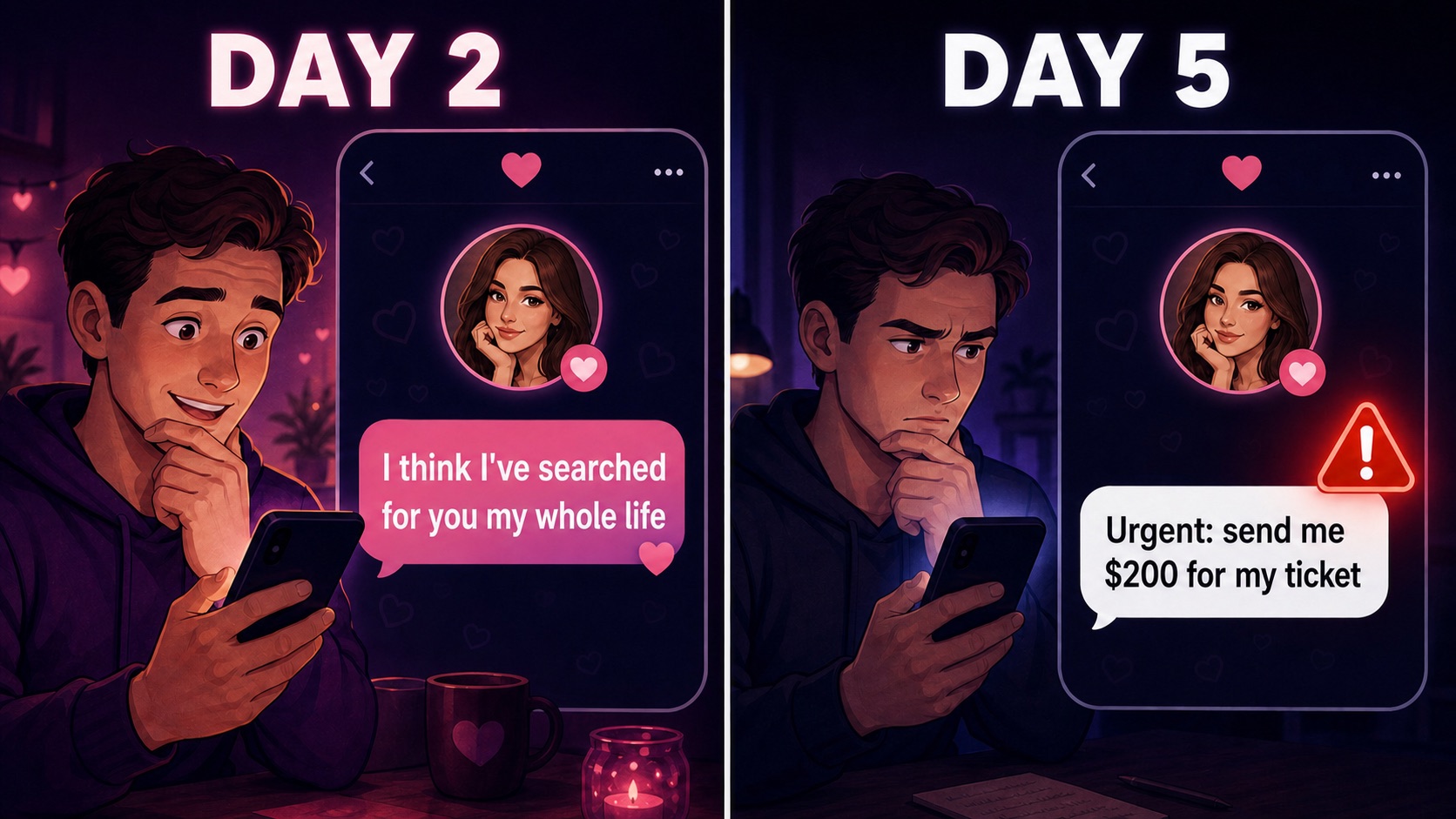
Watch the pattern, not the polish
A fake profile can look more convincing than a real one. It may have excellent photos, a restrained bio and a plausible job. The development of the relationship tells you more than the quality of the page.
A common romance scam follows four stages:
- The person closes the emotional distance quickly and mirrors your interests.
- They move the conversation from the dating app to a messenger, email or private chat.
- They explain why video calls and an in-person meeting are impossible for now.
- They ask for money, payment details, a verification code or help with an investment or transfer.
Moving to another messenger is common. So is an intense conversation. The combination of fast intimacy, an identity that cannot be checked and a financial request is what changes the risk.
Sign 1. Intimacy moves faster than knowledge
After a few conversations, the person talks about fate, a shared future or an exceptional bond. They may message all day, use affectionate names and claim they deleted the app for you. The words feel good, which is exactly why the tactic works.
Real attraction can also move quickly. The difference is how someone reacts to a boundary. A genuine match can accept “I would rather slow down.” A scam depends on momentum because a pause gives you time to compare details and ask someone else for an opinion.
Slow the pace without apologizing. If the response is guilt, anger or a demand to prove your feelings, treat it as pressure rather than romance.
Sign 2. Ordinary identity checks never work
The profile has only one or two perfect photos. New pictures never arrive. Every live video call fails because of bad internet, a broken camera, confidential work or a time-zone problem. Voice notes may not match the writing style.
Use several modest checks instead of relying on one dramatic test:
- reverse-search two or three profile photos;
- search combinations of the name, job, city and distinctive parts of the story;
- suggest a brief live video call;
- compare facts from early and later messages;
- look for an independent digital footprint consistent with the claimed biography.
No reverse-image match does not prove the photo is genuine. It may be new, private or AI-generated. A small social footprint does not prove fraud either. The purpose is to find independent confirmation, not to convict someone with one search result.
A short natural video conversation is enough; do not demand documents or theatrical gestures. Video is not perfect proof because recordings and deepfakes exist. Repeatedly avoiding a simple call after weeks of intimate messages is still a meaningful signal.
Sign 3. The meeting is always close and always cancelled
An offshore job, military posting, family crisis or long business trip creates distance. Those circumstances can be real. The suspicious part is the repeated turn: a meeting is nearly possible, then an obstacle appears that your payment can solve.
The money may be described as a flight cost, visa fee, medical bill, customs charge or emergency debt. The first request can be small. It tests willingness, and later requests grow. Money already sent can also make it harder to admit what is happening.
Use a simple boundary: do not finance someone you have never met and cannot independently verify. A genuine emergency does not make a dating app match the only available source of help.
Sign 4. The conversation becomes financial
Not every scheme sounds like a loan. A match may present themselves as a successful investor and offer to teach you. A website shows early profits, then urges you to deposit more. The balance may be only a number on a fake platform, and every withdrawal triggers another “tax” or “fee.”
Another person may ask you to receive a transfer, buy cryptocurrency, open an account or forward money. They blame a temporary bank problem or international restrictions. Complying can involve you in moving stolen funds.
Stop if a match asks you to:
- pay for travel, treatment, customs, phone service or an emergency;
- buy cryptocurrency, gift cards or digital vouchers and share a code;
- open an investment site from their link or install an app;
- receive money and forward it to another person;
- open a loan, bank account, card or wallet;
- share a card security code, PIN, password or one-time verification code;
- share your banking screen or enable remote access to your device.
Someone does not need your PIN, full card security details or one-time code to send you money. A video call does not make a payment instruction safe.
Sign 5. A link supposedly solves the problem
A match may send a link for identity verification, a restaurant booking, a gift delivery, a private album, a vote or an investment account. The page imitates a known service and asks you to sign in, enter card details or install a file.
Do not open financial or sign-in pages from a dating chat. Find the official service independently. A padlock in the browser only means the connection is encrypted; it does not prove the site belongs to a legitimate company.
Never let an online match configure your phone, obtain remote access or direct actions inside your banking app.
Sign 6. There is no time to think or ask anyone
Romance scams use emotional engineering. Intimacy is followed by urgency: surgery must happen today, the flight price expires in an hour, or an account is about to close. Secrecy arrives with it: “Do not tell your friends; they will not understand us.”
Secrecy blocks verification and urgency blocks reflection. Step outside the chat before making any financial decision. Sleep on it and show the messages to someone you trust. A legitimate request can survive scrutiny and a few hours of delay.
A ten-minute dating profile check
You do not need a private investigation. Use a short protocol that puts facts back into the conversation.
- Save the profile and messages. Capture the username, phone number, links and financial requests.
- Check several photos. Reverse-search more than the main image and compare any names you find.
- Write a timeline. Pull five or six claims out of the chat so contradictions are easier to see.
- Suggest a video call. Treat it as a normal step before meeting.
- Check links independently. Open the official service yourself instead of signing in through a message.
- State a financial boundary. “I do not send money or invest with people I meet on dating apps” is enough.
- Show the chat to someone else. Emotional pressure and repeated scripts are easier to see from outside.
The reaction provides information. A genuine person may be surprised but can usually respect reasonable caution. Guilt, threats, another sudden emergency or a demand for secrecy increases the concern.
What to say when someone asks for money
You do not need to expose the person or win an argument. A long explanation gives them more material for pressure. Keep it short:
I do not send money, share banking codes or open financial links from chats. I am ending this conversation.
Save the evidence, block the profile and report it in the app. If there is blackmail or a threat, do not bargain or send more material. Preserve the messages and contact local law enforcement.
Keep the first meeting low-risk
Even a plausible profile does not replace basic safety. Meet in a public place and arrange your own transport. Tell someone where you will be and when you expect to leave. Do not move the meeting to a home or car under pressure. Keep control of your unlocked phone and drink.
These precautions do not assume every match is dangerous. They simply avoid trusting someone faster than your real experience with them allows.
If you already sent money or exposed information
Shame creates delay; speed is more useful.
- Contact your bank through the number on your card or its official site. Report fraud and ask whether the transfer can be stopped and the card or online access secured.
- Change the compromised account password and every reused password. End unknown sessions and enable two-factor authentication.
- If you installed remote-access software or an unknown file, disconnect the device and get technical help. Do not make new payments from it until it has been checked.
- Save chats, receipts, account numbers, web addresses, phone numbers and profile names.
- Report the incident to law enforcement and to the dating app. If intimate material is used for blackmail, do not pay; payment rarely ends the demands.
A voluntary transfer may be difficult to reverse, but contacting the bank quickly may help stop a pending payment and protect the rest of your funds.
Red flags are a pattern, not a label
Someone may dislike video calls, have little social media presence or live abroad. Those are circumstances, not proof of fraud. Accent, age, nationality, profession and imperfect language are poor shortcuts.
Behavior is more informative. Can the central facts be checked? Does the person respect boundaries? Do their actions match their words? Do money, secrecy and urgency enter the relationship together? When those answers form a coherent pattern, trust the pattern rather than the promise.
The short version is: slow down, verify independently, do not send money or codes, do not install apps from chat instructions, and ask someone you trust before acting. That does not get in the way of a real connection. It gives trust time to become evidence-based.