Sex on the First Date: Should You, and How to Decide for Yourself
The evening is going well, you both feel it, and two thoughts run at once: "I want to" and "what will he think of me tomorrow." The second usually wins, and the decision ends up being about his imagined opinion rather than about you.
That's what this is about. Not permission, but substance: what the date number actually changes, how to separate your own desire from politeness, how to say no without ruining the night, and what to sort out before rather than after.
Where "not before the third" came from
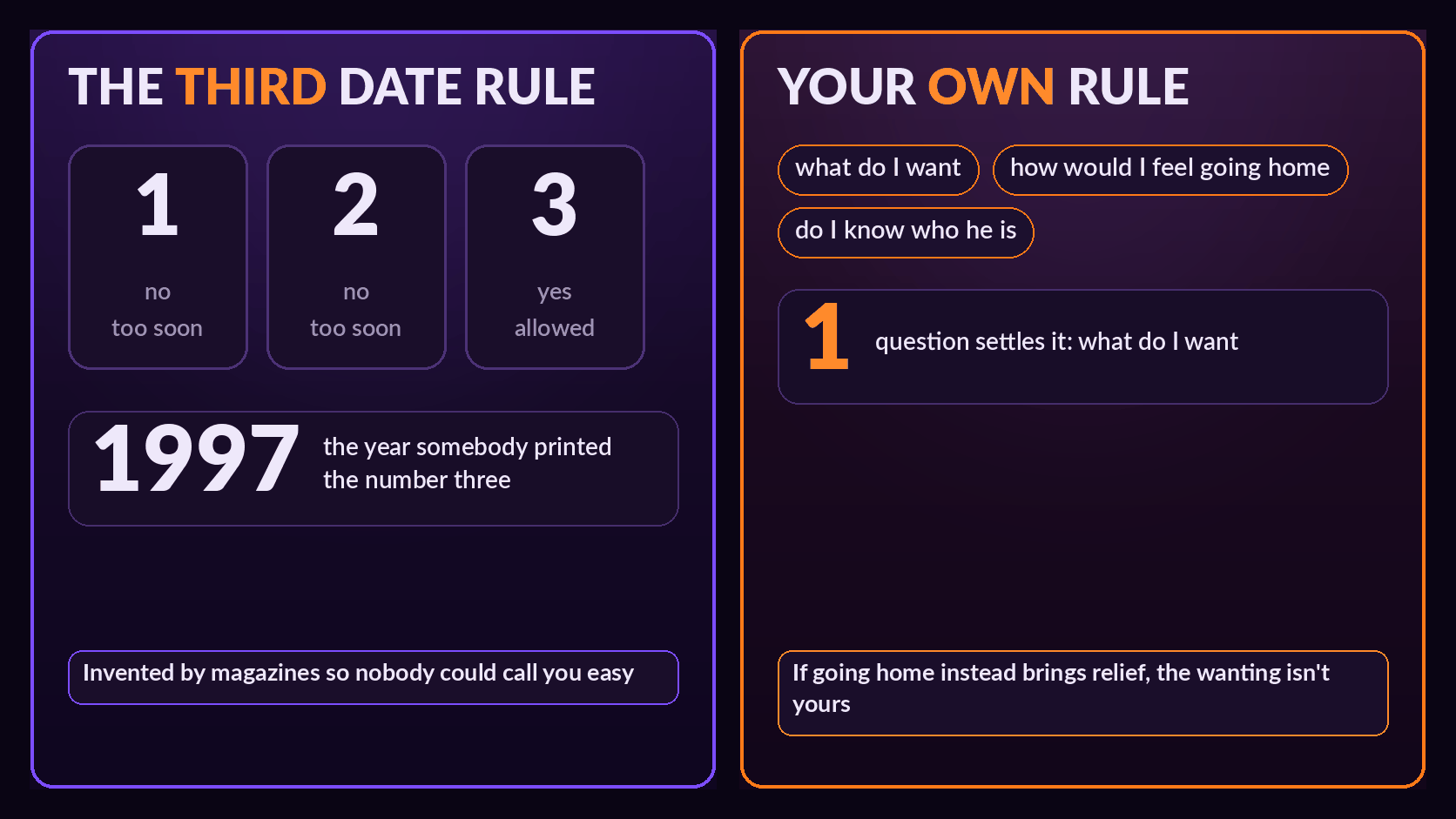
Numbers like "not before the third" came out of magazines and sitcoms that needed to hand readers a simple benchmark. What they measured wasn't desire but reputational risk — how many meetings you have to sit through before nobody can call you easy.
The rule was, in effect, a manual for managing other people's opinion of you. Not for running your own life.
That doesn't make it useless. Just use it as a thermometer rather than a law: wait if waiting feels better to you, not because someone printed the number three in 1997.
What the date number actually changes
Honest answer: almost nothing.
One thing does change — how much you know about him. On a first date you mostly know what he chose to tell you. By the third you have observations: how he handles small refusals, what he says about exes, whether his job story holds up, whether the man in the messages matches the man at the table.
That information is worth having. But it informs a decision about him, not a decision about sex. A man who disappears after the first night will disappear after the fourth too — you'll just have invested more by then.
So flip the question. Not "is it too soon" but "do I know enough about who I'm with, and can I live with either way this evening goes."
Pros and cons of sex on the first date
Laid out honestly rather than by the etiquette book, it looks like this.
Pros. You find out right away whether there's physical chemistry instead of guessing for three weeks. No tension builds up that turns the second and third date into a drawn-out prelude. And you decide while you actually want to, not on a schedule.
Cons. You still know little about him, and if he turns out to be someone other than who he presented, you learn it afterwards. The morning may bring silence rather than a warm "what next", and you won't have braced for it. And if sleeping with him was a way not to disappoint rather than your own wish, the feeling afterwards will match.
None of these points is about morality. All of them are about whether you're ready for either version of the morning. If yes, the pros win. If the thought "what if he vanishes" makes you anxious, that's not a reason to wait for the third date — it's a reason to wait exactly as long as it takes for the anxiety to go.
What men think: will he really respect you less
Partly true, and there's no point pretending otherwise. Some men treat fast sex as grounds to write a woman off. They exist, you will meet them, and no amount of waiting fixes them.
Here's the catch. That man will write you off after the fifth date too — he'll just pick a different reason: agreed too easily, held out too long, wanted too much, wanted too little. The problem is his view of women, not your timing, and it's usually visible while you're still texting.
Which is why waiting as a test works badly. It tests his patience, not his respect. A patient man with a bad attitude simply waits.
Far more reliable: watch the small things. Does he talk over you, does he make dismissive jokes about women, how does he react when you say no to anything at all — the second drink, the change of venue. All of that shows up on the very first evening.
Telling your own desire from pressure
The most useful question isn't "do I want him." It's "how would I feel if I just went home right now."
If the answer is relief, you don't want to — you're agreeing. If the answer is disappointment, you're fine.
Signs you're being moved by something other than desire: you're assembling arguments in your head along the lines of "well, why not," you're worried he'll be offended, you've already spent a whole evening and hate to waste it, or you expect him to become closer afterwards.
That last one is the trap. Sex doesn't create attachment in someone who wasn't planning any. It can deepen what already started. It can't start it from zero.
Saying yes on your own terms
Consent isn't surrender. It's your decision, and it can come with conditions you say out loud.
They can be very plain. "Yours, but I'm leaving tonight." "I don't stay over the first time." "No condom, no sex." "I'm texting my friend the address first." None of these kills the mood for a reasonable man. His reaction is a useful test in itself — anyone who starts negotiating has told you what you needed to know.
Your right to change your mind doesn't expire. Not in the taxi, not at his door, not ten minutes later. Agreeing to go somewhere is not agreeing to everything that follows, and a man who pretends not to see that distinction is pretending on purpose.
Saying no without wrecking the evening
A refusal doesn't owe anyone an explanation. "Not tonight" is a complete sentence.
If you want it softer and with a future attached: "I'm enjoying this and I want to see you again, just not tonight." That contains the no, the invitation, and no room to haggle.
If he haggles anyway — wheedles, sulks, jokes that you led him on, tries again ten minutes later — the evening is over. Not because he's rude, but because you've already seen how he handles the word no. There's nothing further to learn.
A good sign in the other direction: after your "not tonight" he neither cools off nor pushes, and the evening carries on in the same key.
If you're the one who only wants tonight
That's a real thing to want, it's unremarkable, and half the awkwardness around this subject comes from women not being allowed to say it out loud.
The same directness applies as when you're looking for a relationship, just inverted. "I'm not after anything serious," said early, saves both of you time and takes you out of the role where you're supposed to be keeping someone.
Two practical notes. Don't drift into being a permanent casual arrangement if you don't want one — that deal holds only while it suits both people, and either of you can end it any day. And don't confuse your own frankness with an obligation to tolerate disrespect: a man who thinks that not wanting a relationship means you can be treated any way at all has told you exactly what everyone else in this article tells you.
A first date at his place: should you agree
"Come over, I'll cook" sounds cosy on a first meeting and quietly removes all your exits at the same time.
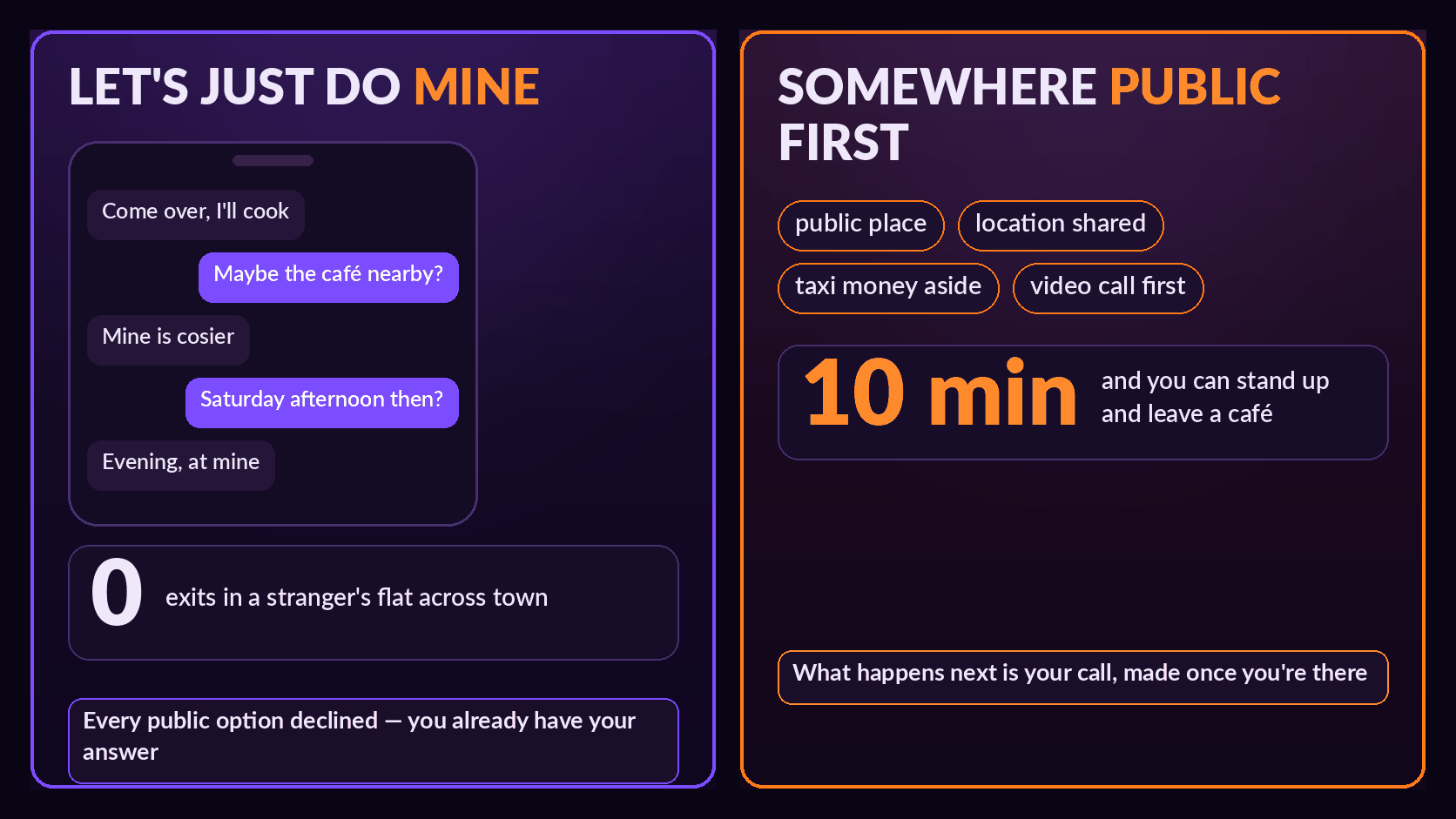
The issue isn't his intentions but the asymmetry. In a café you can stand up and leave after ten minutes. In a stranger's flat across town, leaving is harder psychologically and slower physically, and you feel that before anything has even happened.
The reasonable middle, with no drama attached: meet somewhere public first, and decide about the rest once you're there. If he insists on his place and turns down every public option, you've got your answer about his plans without leaving home.
Safety: what to sort out beforehand
The boring part everyone skips.
- Tell a friend whose place you're going to and share your location — it takes a minute;
- if you met in an app, get on a short video call before meeting in person;
- keep your phone charged and taxi money separate from the rest of the night;
- make the first meeting somewhere public and don't go to anyone's home before it;
- don't leave your drink unattended and don't finish one you walked away from.
Then there's the question of who you're going with at all. If he dodged direct questions about himself, never showed his face clearly, and pushed hard for a fast meeting, slow down. We broke those patterns down in the guide to dating app scammer signs.
The contraception conversation
It takes fifteen seconds and somehow counts as awkward.
Say it first and as a statement, not a request: "I've got condoms, we're using them." Carrying your own is normal, not insulting. A man who "doesn't like them" is proposing that you carry every risk alone, including the ones that end in a doctor's office.
Worth knowing in advance how emergency contraception works — the sooner it's taken the better it works, and it's a matter of hours rather than days. STI testing is something to do periodically regardless of how many partners you have, not only after a scare.
How to tell he's only after sex
Separate question, and worth saying plainly: wanting only sex isn't a crime. Lying about it is.
What's visible early:
- the whole conversation is about your body and hints, with almost no curiosity about you as a person;
- he stays vague about himself — work, neighbourhood, plans, surname;
- every proposed meeting is late and at someone's flat, and daytime options get declined;
- he never asks how you're getting home or whether you got there;
- there's a constant low push in the chat and pauses irritate him.
If you're unsure, look at the whole conversation rather than the last two messages — the chat analyzer shows who's carrying the exchange, where pressure appears and how the tone shifted. Sometimes the picture is obvious at a glance.
The morning after: what to actually expect
First: you owe no particular performance. Not breakfast, not a talk, not a fast exit.
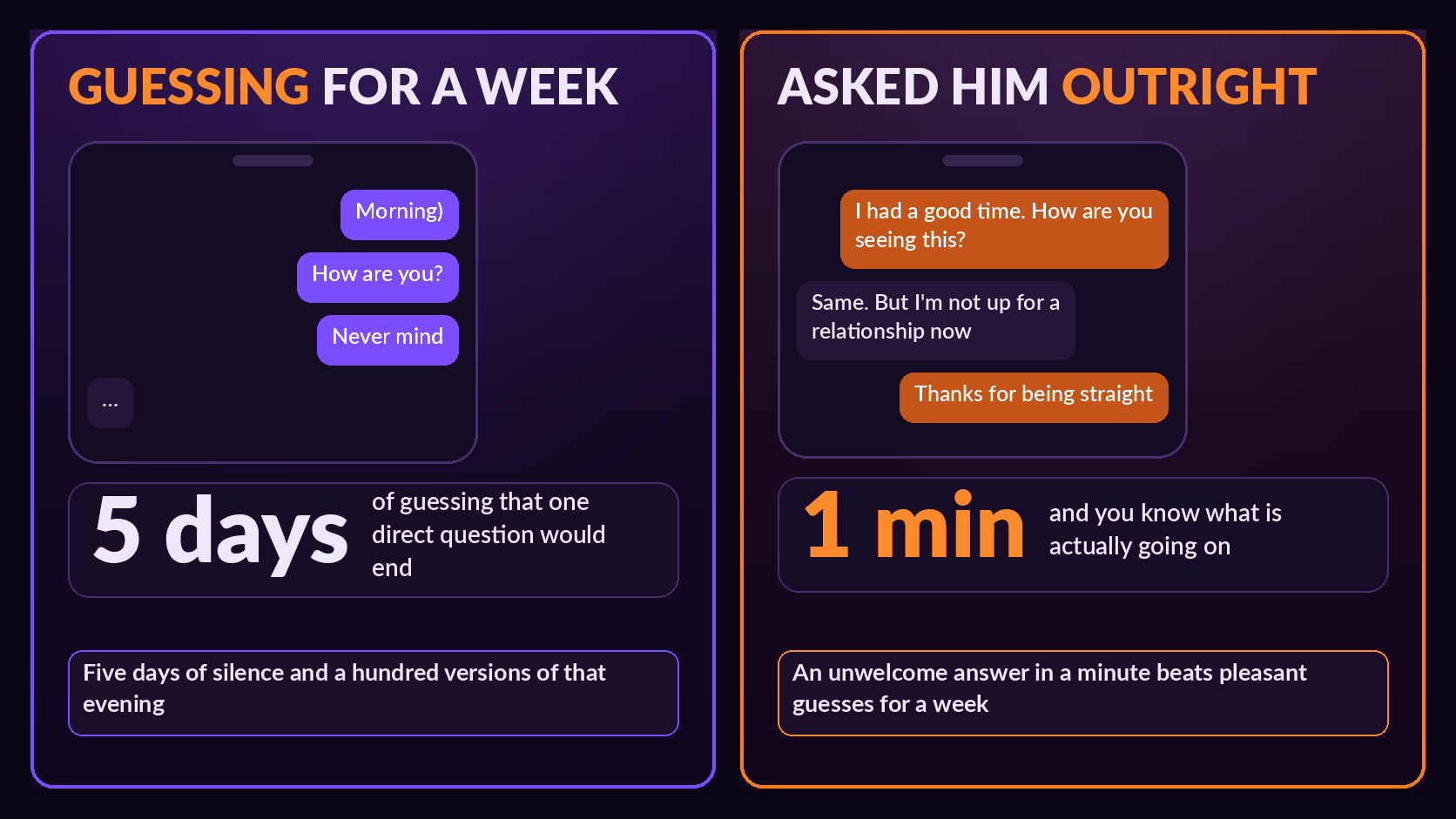
Second: silence in the first few hours isn't a verdict. People sleep, work, and simply don't text in the mornings.
Third: if you want clarity, ask for it. Not "what are we" but something human: "I had a good time — how are you seeing this?" A direct question saves a week of guessing and rarely frightens anyone who's serious.
If he disappears afterwards
It hurts, and the explanation is usually plain: he got what he came for and doesn't need anything else. Not because you did something wrong, but because that was the plan from the start.
What helps. Don't hunt for the fault in yourself and don't rewrite the evening in hindsight. Don't send a series of clarifying messages. And don't convert it into a rule about all men — on the next date that rule will stop you seeing the person in front of you.
The one useful takeaway is whether the signs were there beforehand. They usually were, and next time you'll catch them sooner.
If you want a relationship rather than a night
Then the key skill isn't holding out. It's naming what you're looking for early and calmly.
"I'm not looking for anything casual," said in the second message, filters out half the wrong men without costing you a single evening. It doesn't bother anyone who wants the same thing.
After that it's ordinary observation: does he make plans beyond Saturday, does he let you into the context of his life, is he curious about yours. There's more on the search itself — and on filtering people out while still in the app — in our guide on how to find a boyfriend. If something has already started and you want to check how healthy it is, there's the relationship health test. And the same evening seen from the man's side is covered in what date it's OK to have sex on.
Quick answers
Should I have sex on the first date?
That's yours to decide and there's no universal answer. A useful check: imagine simply going home instead. If that thought brings relief, don't.
Why do people say you shouldn't?
Because "not before the third" was invented to manage other people's opinion of you, not your own desire. The only real reason to wait is that you still know too little about him, or aren't ready for either version of the morning.
Do men really respect you less afterwards?
Some do — but those men devalue women regardless of timing and will just pick another reason. Watch how he reacts when you say no to anything at all, not how many dates you've had.
How do I turn him down without offending him?
"Not tonight," with no explanation attached, is a full answer. If you want the story to continue, add that you enjoyed the evening and want to see him again.
Can I change my mind on the way to his place?
Yes, at any point and without justification. Agreeing to go is not agreeing to what follows, and a decent person needs no explanation of that.
How can I tell he only wants sex?
From the messages: the conversation orbits your body, he's vague about himself, meetings are always late and at home, and he never asks whether you got back safely. Three of those together is a pattern.
He vanished after the first night — what now?
Don't investigate and don't send a run of messages. It's information about his plans, not about your value, and the only useful move is to notice whether the signs were there earlier.
Do I have to wait until the third date?
No. The spread is huge — anywhere from the first to the tenth, all of it normal. A better gauge than the date number is how many hours you've actually spent together and what you've learned about him.