What Date Is It OK to Have Sex On? The Third Date Rule, Explained
People ask what date it's OK to have sex on as if there were a chart somewhere. Second is pushy, third is fine, fifth means you waited too long. No chart exists. What does exist is a short list of things that decide whether an evening ends in one bed or two separate taxis, and the number of the date sits nowhere near the top of it.
Let's take it in order: where the famous third date rule came from, what it actually measures, what readiness looks like, and how to tell it apart from politeness.
Where the third date rule came from
It grew out of American sitcoms, magazine columns and dating books that needed to hand the reader a single number. The logic ran like this: first date is an introduction, second is a test, by the third you're basically a couple and anything goes.
Neat. The trouble is that the rule never measured desire — it measured reputational risk under the manners of a previous century. How many meetings does a woman need to sit through to avoid being called easy, and a man to avoid being called pushy.
The manners changed. The number stayed — under several names: the third date rule, the three-date rule, "not before the third". Same thing.
What the date count actually measures
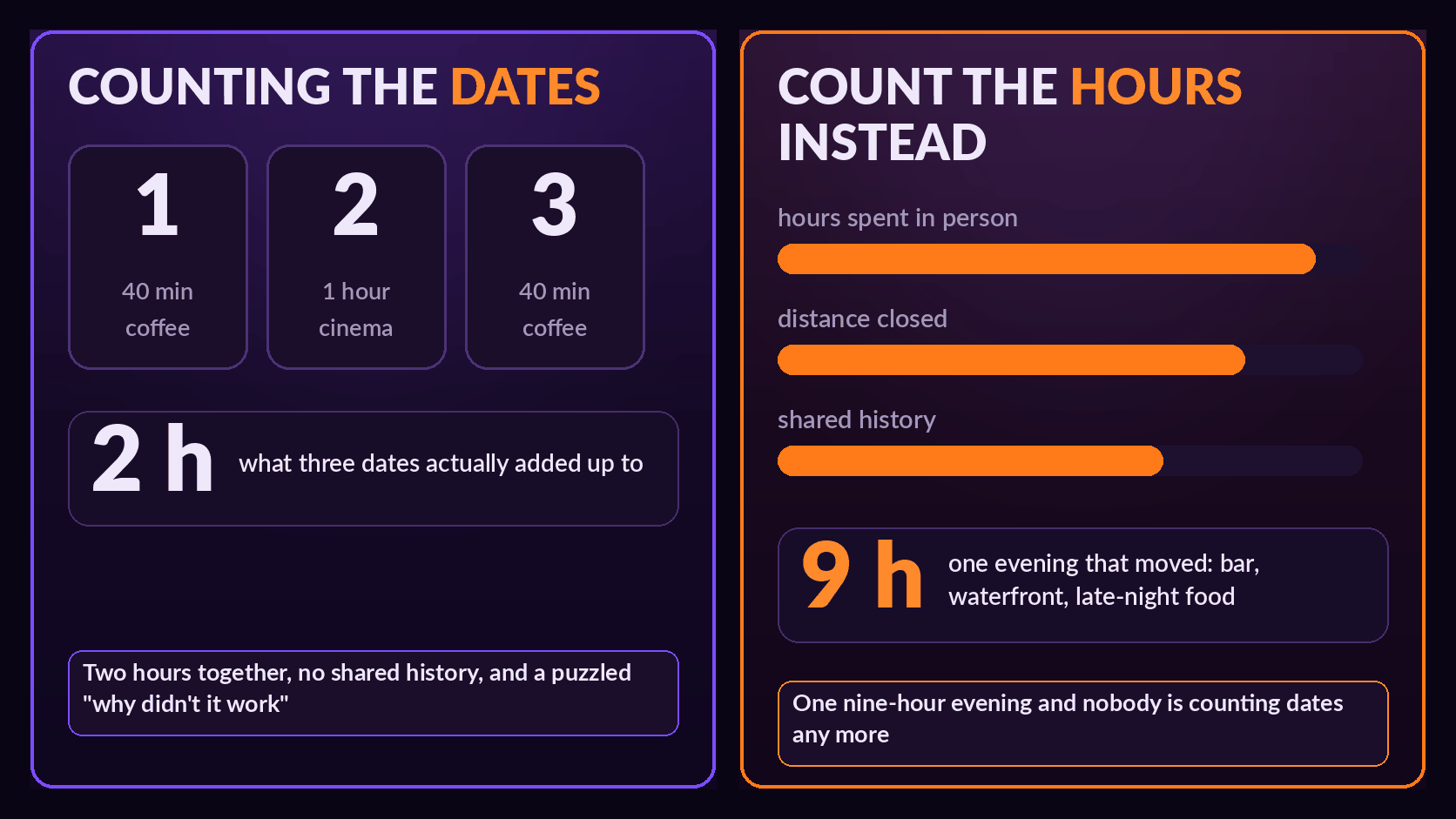
Here's the part people skip: a date is a terrible unit of measurement. Two people can meet three times for forty minutes of coffee and know less about each other than a pair who talked for nine hours straight once and split up at four in the morning.
Count three other things instead.
Hours spent together in person. Not messages. Actual time in the same room, where you can see a face change and hear a voice drop.
Distance closed. Literally — did you sit across from each other or side by side, who moved first, what happened after.
Shared history, however small. One thing survived together — caught in the rain, rescuing somebody's cat, arguing with a driver — does more than three well-scripted evenings.
Once those three are stacked up, nobody is counting dates. Not her, not you.
When it happens on the very first meeting
Often enough, and usually under one of three conditions.
You'd been texting for weeks, so the first date was functionally the fifth — the first four just happened over the phone. Or the evening ran long and moved around: a bar, then the water, then her favourite late-night place at two in the morning. Or both of you knew from the start why you were meeting and neither pretended it was about the film.
What never works is the version where a man spends the whole evening steering toward the bedroom and the woman can feel it. Then it isn't too early — it's that nobody enjoys being an item on someone's agenda.
Why "too early" and "too late" aren't about the calendar
"Too early" is what it feels like when physical closeness outruns emotional closeness. She still doesn't know who you are and your hand is already on her waist. "Too late" is the reverse: months of conversation, not one touch, and the whole thing quietly reclassifies itself as friendship with hints.
The job isn't to guess the right date number. It's to keep those two lines roughly level. That's exactly where most men get it wrong — they invest in one and ignore the other completely.
Sex on the second or third date: what actually changes
Between the first meeting and the third there are usually a week or two and a few dozen messages. Those, not the number itself, make the difference.
By the second date you already know how she texts when she isn't interested, and you've seen how she handled the first "not tonight", if there was one. She knows you didn't vanish after the first meeting and didn't get pushier. Both of you are less afraid of getting it wrong, so intimacy comes easier.
By the third date, logistics join in: you've been to each other's place, or at least near it, and "yours or mine" no longer sounds like a proposal. That's why so many couples "land" on the third date rule — not because it works, but because by the third meeting all of the above has usually accumulated.
Which gives a simple conclusion: if none of that is there on the second date, the third guarantees nothing. And if all of it was there on the first, there's no reason to wait for the second.
How to tell she's ready
Readiness shows up long before anyone says anything. Not in one sign, but in several arriving together.
- She closes the distance herself — sits nearer, turns her body toward you, leaves her hand where yours brushed it;
- touch comes back: you touched her shoulder, a minute later she touches yours;
- she asks about your home life — do you live alone, is it far, who's waiting;
- the evening gets extended on her initiative: "there's another place around the corner";
- her voice slows down and the pauses stop being awkward.
The operative word is together. One item from that list means nothing. Three in a row, each further along than the last, mean almost everything.
When to kiss her: a rehearsal for everything else
A kiss works the same way as everything that follows, only with a much lower cost of error. Which makes it a convenient place to practise reading a situation.
The moment that works is almost always the same one: a pause in the conversation, eye contact held a beat longer than usual, and very little distance left. Not after a joke, not in the middle of her story about work. In the pause.
The mechanics are simple. Close the gap slowly enough that she has a second to react. She either moves toward you or she doesn't. Both answers are useful information, and both beat a week of guessing.
On timing within the evening: kissing in the first twenty minutes is usually early, because nobody has relaxed yet. Saying goodbye without one after four hours of excellent conversation is questionable too — that's where the drift into friendship starts.
Signals you're wrongly reading as a yes
This is where men misread the room most often.
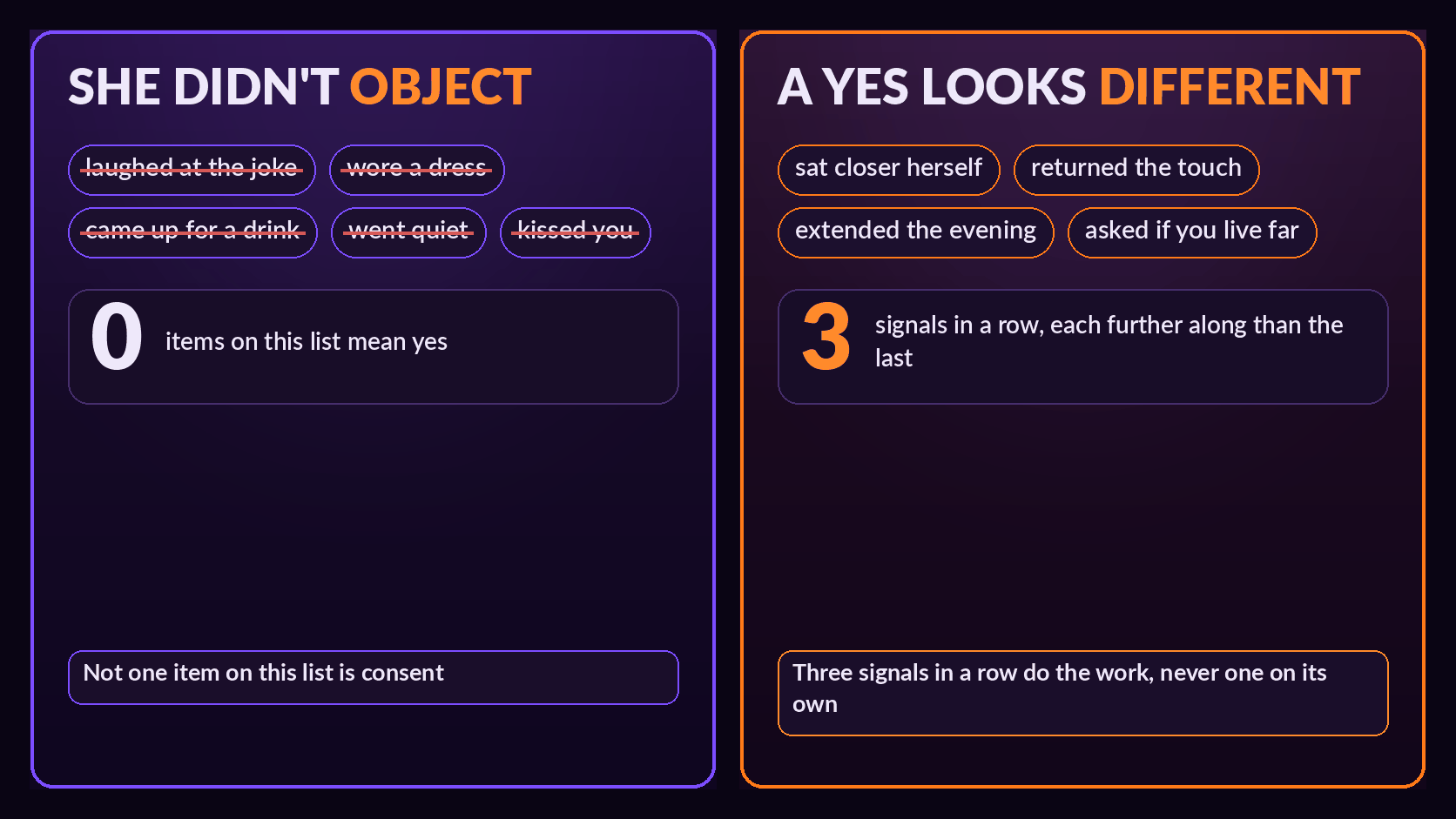
She laughed at your jokes. That's a good mood and basic manners.
She dressed up. That's respect for herself and for the occasion.
She agreed to come up for a drink. Sometimes it's a drink, and pretending you don't know the difference between "came in" and "agreed to everything" is a choice.
She didn't say no. Silence isn't a yes. A woman who has gone quiet and stiff is usually not building anticipation — she's frozen.
She kissed you. A kiss is consent to a kiss.
Quick test: if your argument for "she wants to" sounds like "well, she didn't object," you've stopped reading signals and started inventing them.
How to ask without killing the moment
There's a myth that asking ruins the mood. What ruins it is the phrasing, not the asking.
Nobody needs a legal formula. "Come back to mine?" works. So does "want to stay?" and "tell me if you'd rather not, I'll be fine either way." That last one often has the opposite effect from what men fear: she relaxes because she can see an exit, and that's precisely why she doesn't take it.
You can also ask without words. Close half the distance and wait a second. If she closes the other half, you have your answer. If she doesn't, you didn't get a rejection — you got information, and nothing bad has happened.
In my experience men are far more afraid of the question than women are of answering it.
What to do when she says "not tonight"
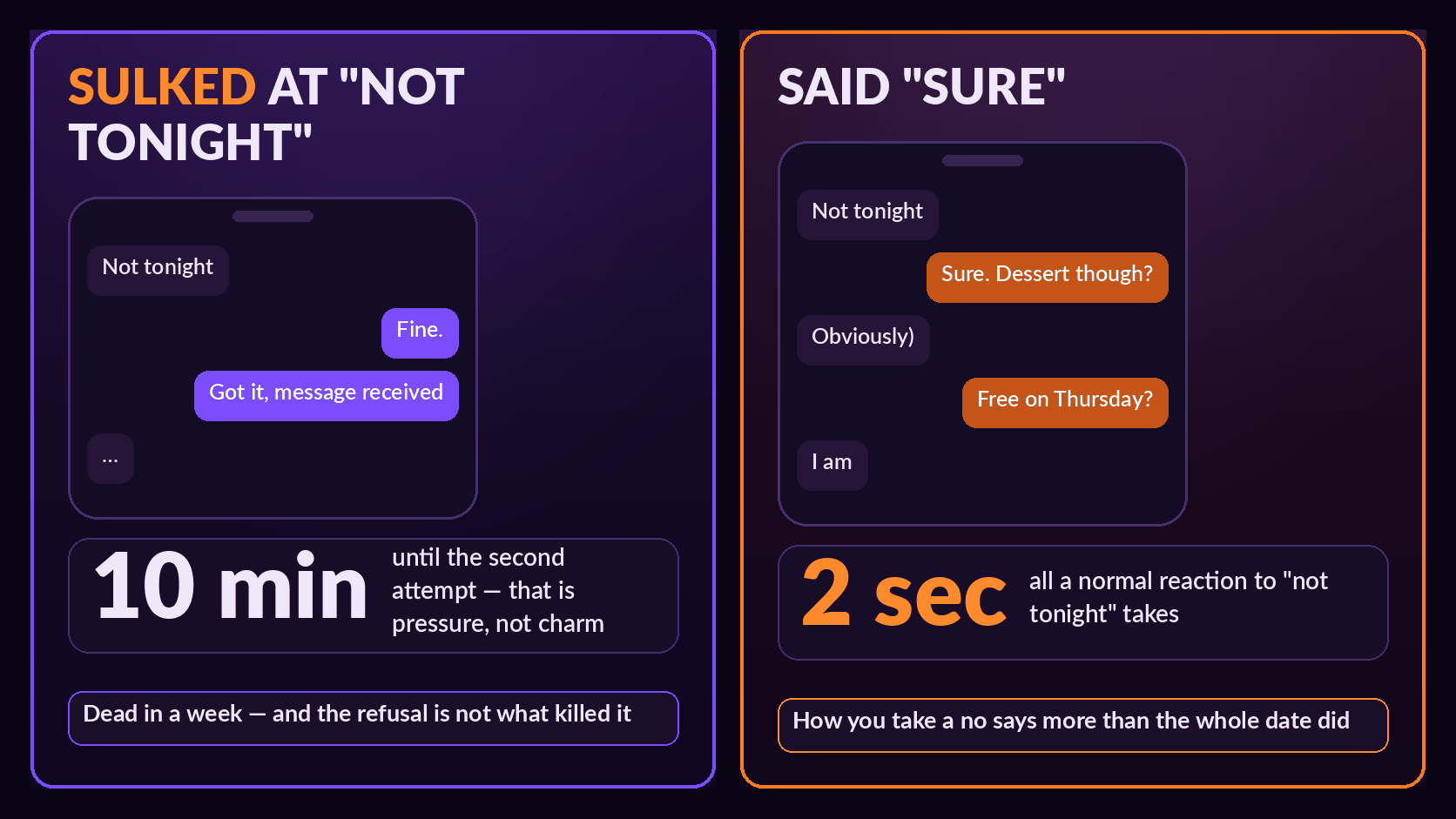
The worst move is to sulk and cool off. It reads instantly, and it moves you from "interesting" to "was after one thing, didn't get it, lost interest."
The normal reaction takes two seconds: "sure," and the evening continues in the same key. No negotiating, no "but why," no second attempt ten minutes later. A second attempt after a no is pressure, however softly it's delivered.
And "not tonight" very often means exactly that. A large share of the stories that die within a week don't die on the refusal — they die on how the man took it.
Logistics decide more than charm
The unglamorous truth: plenty of evenings end in nothing not because the signals were bad but because there was nowhere to go.
She has an hour's commute in the morning, you have a flatmate, she has a flatmate, you met in a part of town nobody can leave after midnight. None of that is about desire, all of it is about transport and square footage, and all of it gets decided when you pick the venue.
Practical version: if you think the evening might continue, meet near one of your homes and don't build a night that ends exactly when the trains stop.
Alcohol: where the line sits
Unpleasant topic, impossible to skip.
Two drinks that loosen someone up and a state where a person is unsteady and won't remember the evening are different categories. In the second, consent is worth nothing — ethically or legally — and the morning can go very badly for you.
The rule is simple. If you're asking yourself whether she's sober enough, she isn't. Put her in a taxi, take her number, text tomorrow. You lose nothing, and often the opposite.
What changes when you met in an app
A couple from an app walks the same path, with two adjustments.
First: you've already spent time on each other before meeting, sometimes weeks of it. For many people that counts, and the first date in person doesn't feel like a first. Hence the sense of hurry that rarely shows up when two people were introduced by friends.
The second adjustment is less pleasant. Someone from an app shares no friends with you, which means no social brakes. Nobody will report back to her circle on how you behaved. That cuts both ways, and it explains why apps produce more rudeness and more morning-after disappearances.
The practical takeaway for anyone not after a single evening: heavy texting is not the same as knowing someone. A couple of hours in person tells you more than a month of messages. If you want to unpack what was happening in the chat before the date, there's our guide to reading a conversation.
The myth that early sex kills a relationship
"Slept with him fast, so it meant nothing." The formula is still in circulation and deserves an honest look.
What breaks things isn't speed but mismatched expectations. A couple who slept together on night one and kept seeing each other looks exactly like a couple who waited until the fifth date. The difference appears when one of them counted it as the start of a relationship, the other counted it as a good evening, and neither said so out loud.
So the question was never which date. It's whether you agree about what happened. One short sentence in the morning covers it.
What to say and do afterwards
The first morning decides more than the night did, and three things carry it.
Don't vanish. Even with no sequel planned, a message is basic decency rather than tactics.
State your position if you have one. "That was good, I'd like to see you again" isn't a declaration of love, it's clarity.
Don't run a debrief. Ratings, comparisons and "did you like it" over text are a fast way to cheapen the whole evening.
If you want a relationship, not just a night
Then the date count stops being interesting at all. What matters is how you talk, how the third meeting compares to the first, and what you avoid saying.
If the sticking point comes earlier — getting from chat to a first meeting — we have a separate breakdown of what to talk about with a girl and a broader guide on how to talk to women. To rehearse the moment where light conversation turns into a direct suggestion, the chat trainer replies differently depending on what you write and shows you afterwards where you pushed too hard. And to see a real conversation from the outside — including the point where interest started dropping — there's the chat analyzer.
It's also worth seeing the same evening from the other side — the same question from a woman's point of view is covered in sex on the first date.
One more thing rarely discussed on early dates: what each of you actually likes. If you're curious about your own preferences, our intimacy preferences test is built for adults and skips the moralising.
Quick answers
What date is it OK to have sex on?
The one where both of you want it and both have made that clear. Most conversations land on the second or third, but the number is a side effect: hours spent together, distance closed and matching intent are what actually decide it.
Does the third date rule really work?
As a code of manners it's obsolete. As a rough forecast it roughly matches reality, because by date three most people have accumulated enough hours together. The number itself guarantees nothing and obliges nobody.
Is sleeping together on the very first meeting a bad idea?
Not if both people want it and both are sober enough to own the decision. The damage comes from mismatched expectations in the morning, not from speed.
How do I know she's ready?
Several signals arriving together: she closes the distance herself, returns touch, extends the evening on her own initiative, asks about your place. A single sign means nothing.
What if she turns me down?
Accept it in two seconds and keep the evening in the same tone, without asking why and without a second run. How you handle a no says more about you than the rest of the date.
Will sleeping together early ruin things?
Not by itself. What ruins it is silence about what it meant to each of you — one honest sentence in the morning removes most of the risk.
How many dates before sex is normal?
There's no single number. Plenty of people land on the second or third, some on the first, some on the tenth, and that spread is normal rather than a deviation.