What to Say After a Match: 30 First Messages for Different Dating Profiles
A match is not a conversation. It is closer to two people making eye contact across a room: encouraging, slightly ambiguous, and not yet a reason to deliver a monologue.
That is why the first message after a match feels harder than it should. People try to prove they are funny, interesting, confident, and unlike everyone else—all inside one chat bubble. The result often reads like an audition. Or it collapses into “hey,” which gives the other person nothing to work with.
There is a better target. Do not try to write the most impressive dating-app opener. Write the easiest interesting message to answer.

The 30 first-message examples below are organized by what is actually visible in the profile: a pet, a trip, a prompt, a nearly empty bio, a clear dating goal, or a useful contradiction. They are not scripts to copy blindly. Think of them as editorial patterns: notice one real thing, give it an angle, and leave a clean lane for the reply.
The three-part opener that rarely sounds copied
A strong first message usually does three small jobs.
- Notice: point to something the person chose to show.
- Angle: add a little interpretation, humor, or curiosity.
- Opening: ask something that can be answered without writing an essay.
Suppose a profile includes a dog on a hiking trail. “Cute dog” is a notice with no opening. “What breed?” has an opening but no personality. “Be honest: did you choose the trail, or did the dog?” contains all three parts. It is specific, playful, and answerable in one line.
There is a nuance people miss: personalization is not the same as investigation. You do not need to identify the restaurant from a reflection in the window or search a name from a work badge. Use details the person intentionally placed in the profile. Anything else can feel less like attention and more like surveillance.
Read the profile like an editor, not a detective
Before typing, scan for a detail with conversational energy. The strongest hooks are usually choices: a hobby, a place, a book, a joke, a dating goal, an oddly specific opinion. Looks are obvious, but they are often a weak opening because they do not create a subject.
When the profile is dense, choose one detail rather than proving you read everything. When it is sparse, acknowledge the limited material without punishing the person for it. “You gave me nothing to work with” sounds irritated. “Your profile is mysterious, so I’m taking a calculated risk” keeps the same truth and loses the complaint.
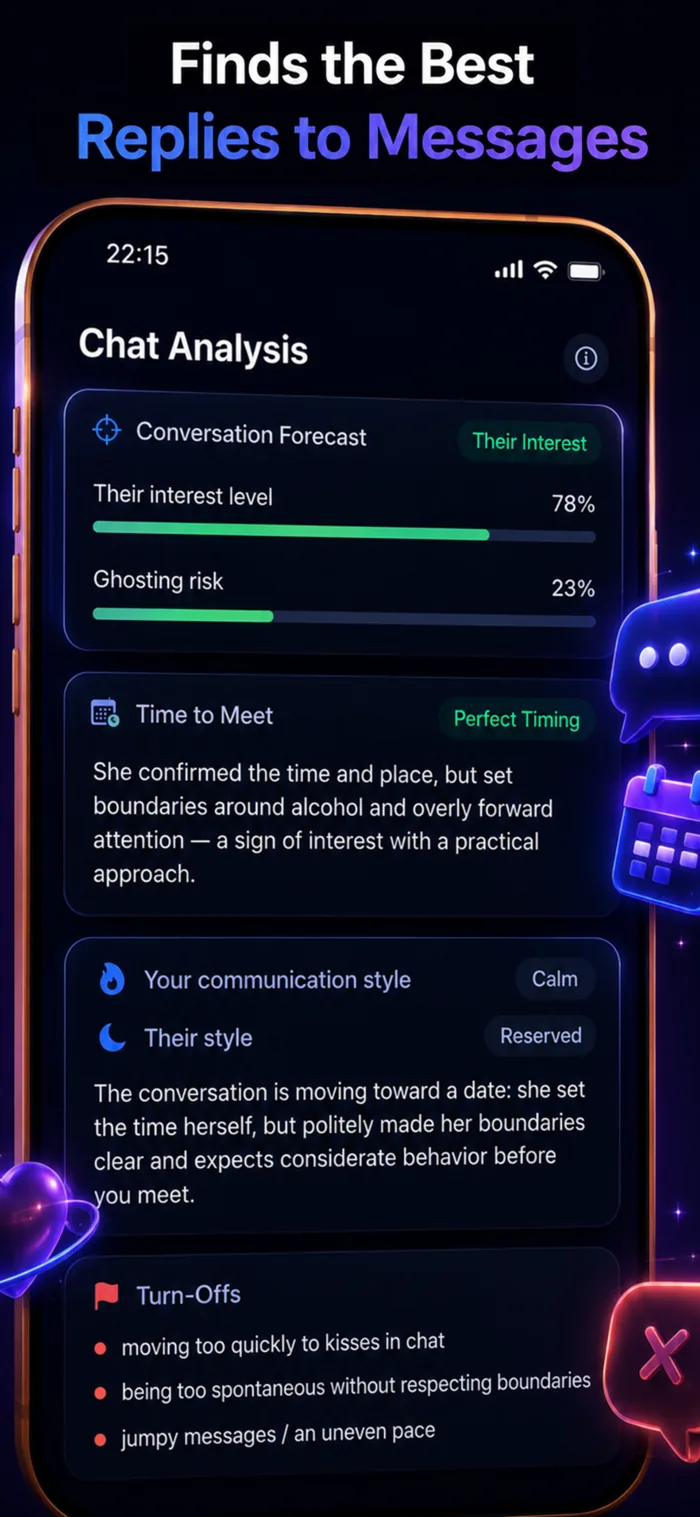
ProRoast can read profile screenshots and suggest openers in different tones. The useful part is not outsourcing your personality. It is spotting hooks you skipped and testing whether your draft sounds warm, playful, or more intense than you intended. The final line should still sound like something you would say out loud.
Profiles built around photos and hobbies
These profiles are generous: they contain objects, places, and activities that naturally produce questions. Resist describing the picture back to its owner. Add a point of view.
1. The dog is clearly the co-star
I need the honest version: did you choose that trail, or did the dog?
Why it works: the question includes the pet without falling back on “cute dog.” It also lets the person talk about the hike, the dog, or both.
2. There is a travel photo with an actual sense of place
That Lisbon shot looks suspiciously well planned. What was the best thing you found by accident?
The contrast between “planned” and “by accident” invites a story. Swap in the real location only when you are reasonably sure. Confidently naming the wrong city is a clumsy start.
3. The profile is all mountains and early mornings
Sunrise hike or civilized breakfast first? Your photos suggest I should choose carefully.
Two-option questions work because they reduce the effort of replying without closing the conversation. The small tease gives this one more life than “Do you like hiking?”
4. They cook—and there is evidence
You made the pasta in photo three, right? I’m prepared to be impressed or respectfully skeptical.
This creates a playful claim the other person can confirm, deny, or defend. “Respectfully” matters. Teasing should feel like an invitation, not a test.
5. A concert photo dominates the profile
You get one song to prove that show was worth the crowd. What are you picking?
Music questions often fail because “What do you listen to?” is enormous. One song is a manageable decision and an easy bridge to a second message.
6. A recognizable book is in the frame
I spotted “[book title].” Is it cancel-plans-to-finish-it good, or just very photogenic?
Mention the title only if you can read it. This opener also gives a graceful exit if the book was merely a prop in a café photo.
7. Museum or gallery pictures
Which museum rule are we breaking first: reading every label or pretending we know what the abstract piece means?
The message proposes a shared scene without prematurely asking for a date. It is flirty because it imagines chemistry, not because it announces it.
8. A sport appears more than once
Pickleball twice in one profile: are you recruiting a partner or warning me about your competitive side?
Repetition is evidence. If someone chose two photos of the same activity, it is safer material than a background detail they may not care about.
Profiles that give you a written prompt
Prompts are not questionnaires. The weak move is answering them literally and stopping. A better message responds, then adds a new direction.
9. The bio has dry humor
Your bio has the confidence of someone who already knows the group-chat verdict. Should I be concerned?
This matches the tone without trying to out-joke the writer. Humor works better as rhythm than as a contest.
10. They post an “unpopular opinion”
I’ll trade you one unpopular opinion for one defense of yours. How attached are you to this take?
The exchange feels balanced. It avoids opening with “You’re wrong,” which can be fun after rapport and exhausting before it.
11. Food is basically the personality section
Quick compatibility test: hole-in-the-wall tacos or the reservation you had to set an alarm for?
This is culturally natural in the U.S., concrete, and low stakes. It can lead to favorite spots, neighborhoods, travel, or an eventual date without forcing any of them.
12. Coffee receives suspiciously detailed treatment
Your coffee order sounds like it has a backstory. What happened to plain drip?
The line works because it treats a small preference as a piece of character. If their order is actually simple, reverse it: “Black coffee. Minimalism or survival?”
13. The profile is career-forward
When you’re not collecting deadlines, what do you happily lose an afternoon to?
Do not interview someone about their résumé. This question acknowledges ambition, then makes room for the person outside work.
14. They are new in town
You get one local recommendation from me, but I need a category: food, view, or place to disappear with a book?
Offering help is warmer than demanding their first-week review of the city. Three categories also make the reply almost frictionless.
15. They speak several languages
Which language gets your best jokes—and which one gets you in trouble?
It is more revealing than “How many languages do you speak?” and does not turn a personal history into a trivia check.
Sparse profiles without much to quote
Minimal profiles require restraint. Make one light inference, label it as an inference, and give the person room to correct you. Do not manufacture intimacy from a face and a first name.
16. No bio, but three very different photos
Your profile gave me three genres and no plot. Which photo is closest to a normal Saturday?
The line names the problem without scolding. It also lets the match choose which version of themselves to explain.
17. Mostly selfies, one interesting background
Calculated guess: the tiny record store in photo two matters more than you expected me to notice. Am I right?
Use the environment, not an invented personality trait. “You look adventurous” is generic. A record store is evidence.
18. Every picture is a group picture
Your friends look like they could turn dinner into a six-hour event. Accurate, or was that a rare organized moment?
Avoid the tired “Which one are you?” joke. The match knows the cropping is imperfect. Ask about the social energy instead.
19. The profile is intentionally private or faceless
I’ll skip the guessing game: what kind of conversation were you hoping to find here tonight?
Respect the boundary already on display. Asking for a face photo in the first line makes the interaction transactional before it has started.
20. The entire bio is “ask me”
All right, one question with consequences: what topic could keep you up past your bedtime?
“Ask me anything” transfers all the labor to the other person. This answer accepts the invitation but chooses a question with range.

Profiles that signal pace, intent, or personality
Here the hook is not an object in a photo. It is the kind of interaction the person appears to want. Match that signal without pretending you already know them.
21. They say they want a relationship
What’s a small everyday ritual that makes a relationship feel good to you?
This is more human than “What are you looking for?” because the profile already answered that. The question moves from label to lived experience.
22. They are direct about keeping things casual
You seem refreshingly clear. For a first meet: one good drink, a walk, or something with a built-in exit?
Direct does not mean careless. The message respects the stated pace and quietly signals that comfort and boundaries remain part of the plan.
23. The profile celebrates staying in
Low-key night draft: takeout, one excellent episode, and no one pretending the loud bar is fun. What are we ordering?
This mirrors the profile’s energy and paints a scene. It is still hypothetical, which keeps the opener from feeling like an invitation into a stranger’s home.
24. They seem to know every bar and every person in it
Are you the one who starts the night, saves the night, or convinces everyone there should be an after-party?
The three roles give an extrovert something entertaining to claim. They also reveal social style without asking for a personality type.
25. Games, sci-fi, or a deep niche fandom
Important compatibility issue: co-op teammate, ruthless rival, or enthusiastic person who forgets the controls?
You do not need expert knowledge to use a fandom hook. Honest curiosity is safer than bluffing and being exposed two messages later.
26. Astrology or another belief system is prominent
I know enough astrology to be dangerous and not enough to defend myself. What would your chart warn me about first?
The opener neither mocks nor performs belief. It lets the match set the seriousness level.
Profiles where the best hook is the overlap
Shared details are powerful because they reduce distance immediately. The risk is overclaiming—one mutual interest does not make two strangers soulmates. Keep it light.
27. You recognize the neighborhood
Settling a local dispute: is [place] actually good, or do we all just live close enough to keep going?
Local humor creates an instant “we,” but the question remains open enough for disagreement. Do not mention a precise home or work location.
28. You share a music obsession
We both put [artist] in the profile, so I need the non-obvious pick. Which track earns your case?
“Non-obvious” keeps the exchange from ending with the biggest hit. It also gives you an easy second message: your own pick.
29. You selected the same oddly specific interest
We both chose [interest], which means either excellent judgment or a very niche problem. How did you get into it?
This works especially well with interest badges because the overlap is explicit. The joke is shared, not aimed at the person.
30. Their profile contains a useful contradiction
Your bio says “spontaneous,” but that color-coded calendar in the photo has questions. Which version wins on a Friday night?
Contradictions create texture. Phrase the observation as curiosity, not a gotcha. The goal is to uncover a story, not win a cross-examination.
What not to send in a first message
The list of things that do not work is shorter than the list of things that do, and it saves more time.
- "Hey, how are you?" Technically a question, functionally a handoff. The answer will be one word long.
- A looks compliment as the entire message. "You're gorgeous" signals interest and supplies no topic. Half her inbox already said it.
- A rating instead of curiosity. "Finally, a normal profile" sounds like praise, but it is built on a comparison with other people.
- Complaining about an empty bio. "You didn't write anything about yourself" opens with a grievance.
- A copied line. Recycled openers are easy to spot, especially if the same one already arrived that morning.
- Going sexual immediately. Sending it early does not make it bold. It makes it something a stranger now has to manage.
- A wall of text. Three paragraphs about yourself before the first reply reads like an application, not an introduction.
One rule covers most of it. If the message could go to anyone in your queue without changing a word, it is not about this profile.
Starting a conversation outside a dating app
On social media and in messaging apps the context is different. There is no profile to quote, but there is usually a shared reason to write: a group chat, mutual friends, an event, a comment under a post. That reason replaces the profile hook.
Three openings that work:
- Shared context. "We both survived that budget call yesterday. How did you keep a straight face?" The reason for writing is obvious to both people, which removes the "who is this" question.
- A reply to something she published. A story, a post, a comment. Reacting to a specific thought reads fine. Reacting to her profile picture does not.
- Continuing an offline conversation. If you met in person, bring back a detail rather than a fact: not "this is Sam from the party" but "Sam, who argued with you about that show and still disagrees."
A few things to avoid here specifically: voice notes before the first reply, messages at three in the morning, and splitting one thought across eight consecutive lines. All of it reads as pressure before the conversation has started.
How to make any example sound like you
Copying a line word for word is tempting, especially when the cursor has been blinking for ten minutes. Do one edit first. Replace the object, location, or choice with something actually visible in the profile. Then read the sentence out loud. If you would never say “refreshingly clear” in real life, change it to “I like the directness.”
Tone also needs calibration. A playful profile can carry a light tease. A sincere one often responds better to plain curiosity. Sexual language in a first message is not confidence when the profile has not invited it. It is simply making a stranger manage your intensity.
A useful check is to imagine the shortest possible answer. If the only response is “yes,” “no,” or “haha,” the message may be a closed door disguised as a question. Give the other person two or three handles: a choice, a small story, or a chance to correct your guess.
The second message is where the conversation becomes real
An opener earns a reply, not a date. When the person answers, stay with their answer for one beat. If they name the accidental Lisbon discovery, ask what made it memorable before jumping to “We should go sometime.” If they choose tacos, offer your favorite spot and ask for theirs.
This is the part no list of dating icebreakers can automate completely. Good conversation is responsive. You notice what the other person gives you, add something of your own, and send the ball back at a comfortable speed.
That is enough. No performance required.
If you would rather test your lines somewhere other than on a real person, try the AI chat texting trainer: five messages, three characters and a breakdown of what held her interest and what killed it. And for where the conversation goes next, we have a separate guide on what to talk about with a girl over text, on the phone and on a date.
Quick answers
What do I write if there is nothing in the profile to work with?
Say so, lightly: "Your profile is deliberately mysterious, so I'll guess — either you're very busy or you signed up ten minutes ago." Admitting the missing information turns it into the topic.
How long should a first message be?
One or two lines. The job of an opener is to earn a reply, not to introduce you. Everything else fits into the next ten messages, once there is a conversation to put it in.
Do compliments work?
They do when they are not about looks. "You have a suspiciously precise taste in films" gives her something to answer. "You're beautiful" does not. Complimenting a choice, a joke, or a decision almost always lands better than complimenting a face.
Should I message first if she liked me?
Yes. A like is permission, not a message. Whoever writes first also picks the topic, which is an advantage rather than a concession.
Can I just say "hey"?
You can, and sometimes it works. But "hey" hands all the work to the other person and lands in a queue where it is already the fifth one that day. One detail from her profile next to it changes the odds completely.
What if the first message gets no reply?
You can come back once after a few days with a new thought, not with "you there?". If that goes nowhere, move on. Silence is usually about a crowded inbox and a mood, not about the quality of your line.
Does it have to be a question?
No, but it needs a handle. Sometimes a statement worth arguing with works better: "I'm betting the dog picked that hiking route." Answering that is as easy as answering a direct question.