What to Talk About With a Girl: Topics for Texting, Calls and Dates
"I never know what to talk about" sounds the same whether you're three messages into a dating app or three dates into something real. The usual cure is a list: a hundred questions, fifty openers, ready-made scripts. It rarely works, because the problem was never a shortage of topics. Let's look at where the silence actually comes from, and what to fill it with over text, on a call, on a walk and across a table.
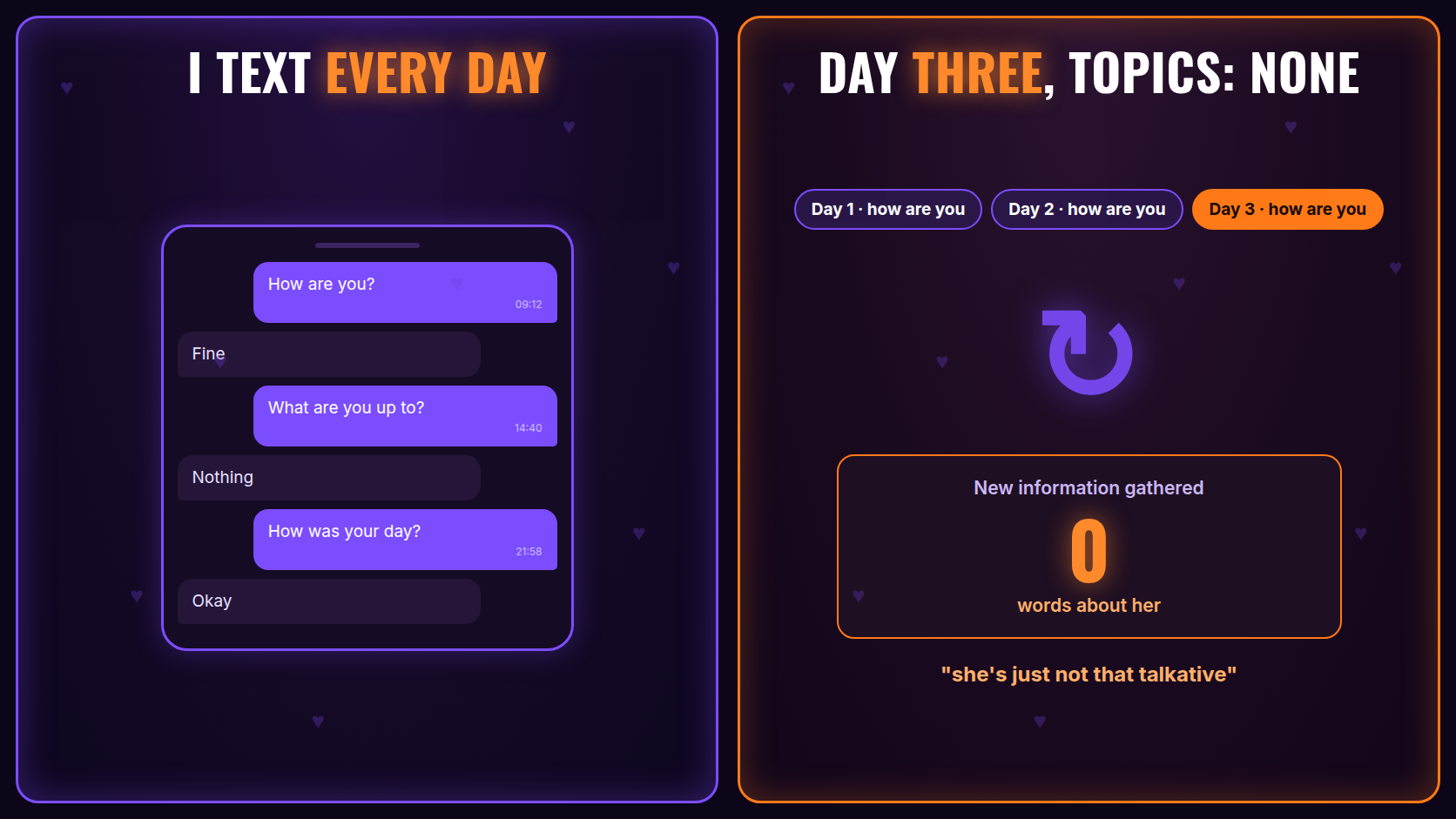
Why a list of topics doesn't save you
Imagine you memorised thirty topics. The conversation still stalls — just two minutes later.
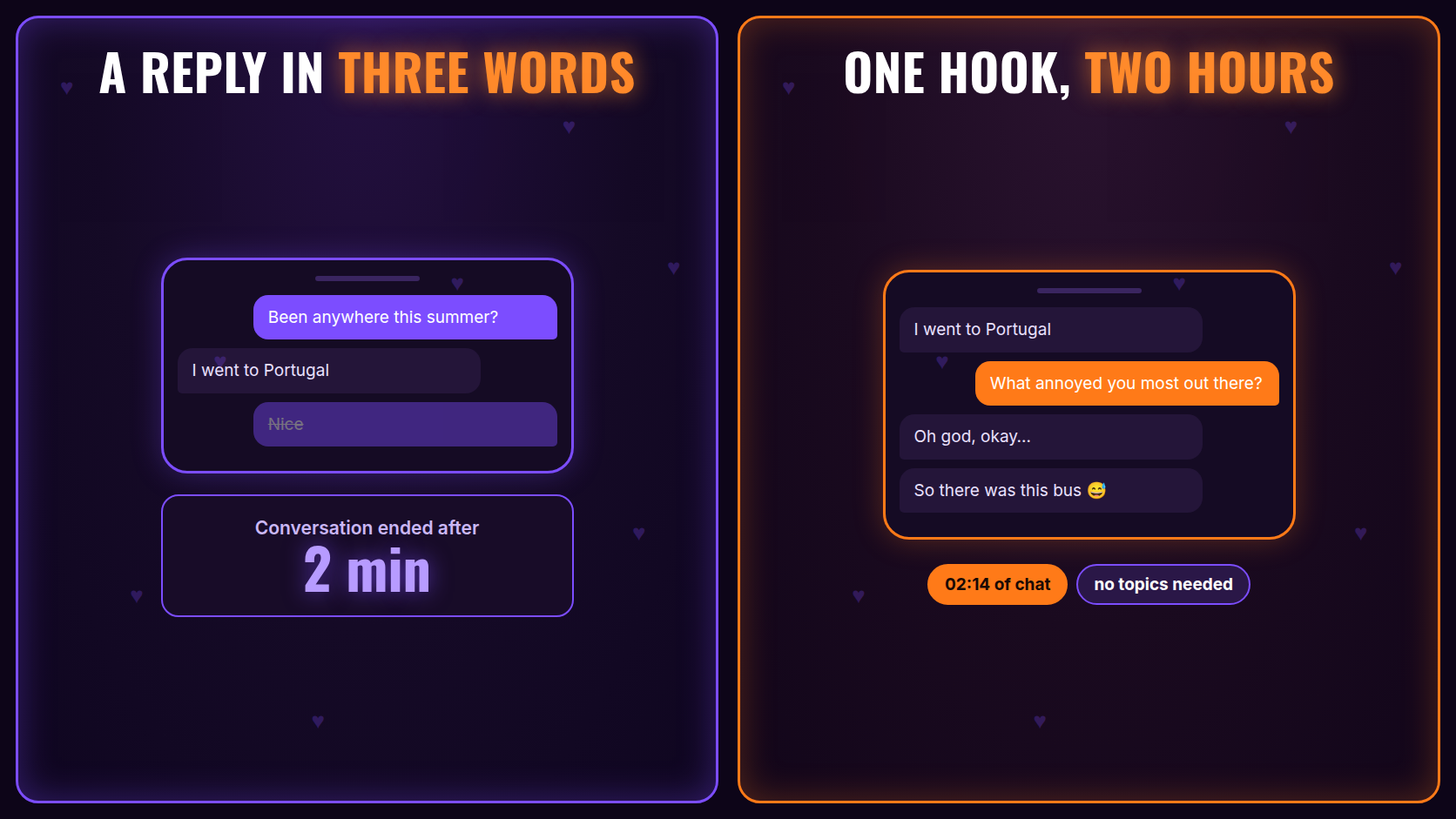
A topic doesn't create a conversation. What creates a conversation is what you do with the answer. You can ask about travel, get "I went to Portugal", say "nice" and find yourself right back where you started. Or you can pull half an hour out of those three words: what she liked, what annoyed her, whether she'd go back, who she went with, where she's dreaming of next.
Which gives us a simple rule. You need one topic to start. After that the conversation runs on your reactions, not on new topics.
One note on who this is for. All of it is symmetrical — the mechanics of texting a girl and texting a guy are identical. Everything below says "her" for brevity, but it works the same in both directions.
Three moves that replace the list
Almost any dying conversation comes back with one of three moves.
Go specific. She said she likes cooking. Don't move to the next item on the questionnaire — ask what she cooked last and how badly it went. Detail is always more interesting than category.
Trade a story, not just a question. A question without your own contribution turns the chat into an interview. When she says she likes mountains, don't reply "which ones?" — reply "I tried Ben Nevis last year and gave up halfway, what have you climbed?". Now there's something of you to grab onto.
Ask for an opinion, not a fact. Fact questions — where do you live, what do you do — close in one word. Opinion questions open a person up: what would you do if you didn't have to work tomorrow.
Hold those three in mind and "what do I talk about" stops being a question.
What to talk about with a girl over text
Texting differs from talking in one important way: she has the option of not replying. So what matters isn't the topic, it's how easy your message is to answer.
What works in chat:
- whatever is visible in her profile and stories — a gig photo, a book on the shelf, a dog, a skyline;
- her near future — the weekend, a trip, a move, an exam, a renovation;
- mutual recommendations — a series, a podcast, a place worth walking to;
- something funny from your day, told as a story rather than a status report;
- light hypotheticals — where would you go right now if the flight were free.
What kills chat: "how are you", "what are you doing", "good morning" with nothing attached. Those aren't topics, they're polite placeholders. There's no way to answer them except with an equally empty line, and after three rounds the thread quietly dies.
There's a mechanical side too. A lot of texting well is length and rhythm. A ten-line message applies pressure, a one-word reply reads as disinterest. Rough guide: write about as much as she does. If you want to see how your thread looks from the outside, run it through the Chat Analyzer — it shows who's carrying the conversation, where you pushed too hard and the point where interest started to drop.
How to start when you've just met
First messages are their own genre. There's no shared context yet, so you have to work with whatever little is visible.
The reliable shape: one concrete detail from her profile plus a question she can't answer with "yes". Not "hey, how's it going", but "saw the shot from Lofoten — did you go for the northern lights or did it just happen?". It proves you actually looked, and it hands her an obvious way in.
If the profile is empty there's nothing to grab, and light observation or self-deprecation does the job instead. We went through examples for different profile types in the guide on the first message.
There's also the case where you met in person first and the texting starts afterwards. Lean on what already happened — "still thinking about your story about the cat" beats any fresh opener.
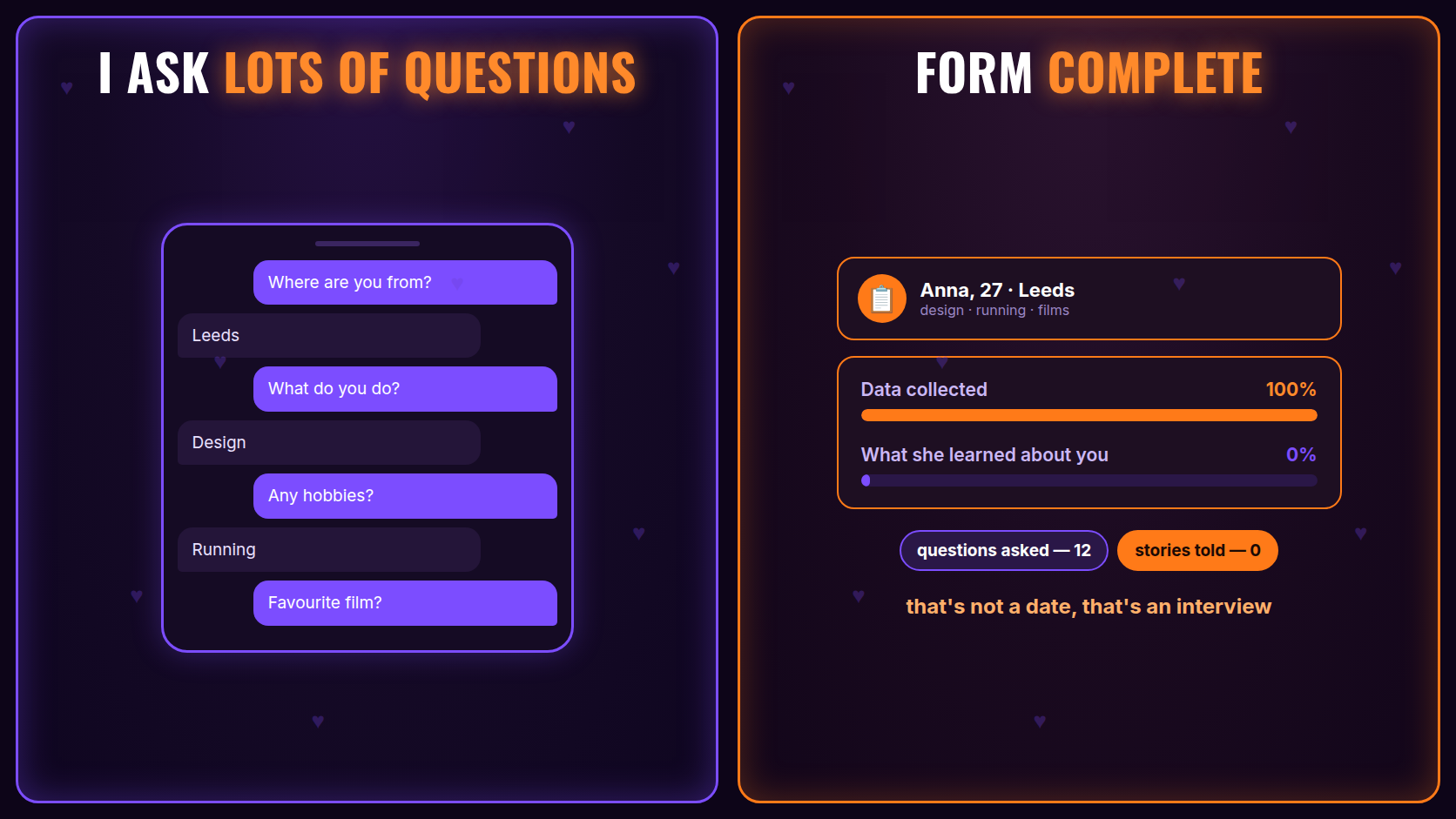
Topics that almost always land
If you do want an actual list of topics, these are the ones that rarely fail, because everyone has something to say about them.
- childhood and the town she grew up in — nearly bottomless, and emotional;
- work, framed not as a job title but as what's good and what's infuriating about it;
- food: the favourite place, what she cooks, where she's been meaning to go;
- travel as "best and worst" rather than a list of countries;
- fears and quirks — heights, hating phone calls, superstitions;
- the plan she keeps postponing — a course, a move, a tattoo, a licence;
- school and university: the favourite subject, the hated teacher, the dumbest thing she did;
- music, and what was in her headphones at fifteen.
Notice that nearly all of them are framed through personal experience rather than category. "What's your favourite food" is dull. "What did you eat as a kid that seems insane now" is a conversation.
What to talk about on the phone
A call sits between texting and meeting, and it has its own rules: pauses are audible, and you can't hide behind an emoji.
So phone calls favour topics that unfold into a story. Not "how was your day" but "what was the stupidest thing that happened today". Anything describable works well — where she is right now, the view, the people around, what she's making for dinner.
Second rule of calls: don't run them into the ground. Better to end on a high than after you've both gone quiet. Twenty lively minutes beat ninety with holes in them.
And third: a call is a great moment to suggest meeting. Tone carries, saying no is harder and saying yes is easier.
What to talk about on a walk
A walk has a built-in advantage texting doesn't: things keep happening around you. Passers-by, shop windows, dogs, an absurd sign, the weather — all free material.
So in person you rarely need a prepared list. What you need is the habit of commenting on what's in front of you and asking what she makes of it. "Who do you reckon lives there", "would you eat in a place like that", "imagine we had to hide from the rain right now".
Talking while walking is easier than talking across a table: no continuous eye contact, pauses don't press, and the route keeps feeding you material. If conversation is hard for you, a walk is the gentlest possible format for a first meeting.
What to talk about on a date
Sitting down raises the stakes. You're facing each other, and gaps show.
What to bring to a date:
- two or three stories about yourself that you enjoy telling;
- a couple of opinion questions rather than fact questions;
- a willingness to talk about what's happening right now — the food, the room, the music, the table next to you.
What to leave out on a first date: exes in detail, money, health, politics and complaints about life. Not because they're forbidden, but because they're early — those need trust that doesn't build in an hour.
A good sign it's going well: you're both interrupting each other rather than taking turns.
How such an evening ends is a separate question, and we've covered it in what date it's OK to have sex on.
How to keep it going when it stalls
A pause isn't a disaster, it's a signal that the current thread ran out. There are three ways to open a new one.
Go back. "You said earlier that project was driving you mad — how did it end?" It reads as attentive and it almost always works.
Change the scale. If you were on something specific, go general, or the other way round. From "what are you watching" to "do you finish shows you don't like, or drop them?".
Name the pause out loud. "Right, I've gone blank" is more honest and more likeable than visibly hunting for a topic. Awkwardness, once named, stops being awkward.
When it's genuinely boring
Two very different situations get called boredom, and they're worth separating.
The first: it's boring because the conversation is running in questionnaire mode. That's fixable — the three moves above, stories instead of questions, detail instead of category.
The second: it's boring because you and this person really don't have much to say to each other. Different interests, different pace, different sense of humour. No technique fixes that, and it isn't worth months of texting. If you want to look at the fit from the outside, there's our compatibility calculator.
Telling them apart is easy: in the first case you want the conversation to work, in the second you want it to end.
Talking to someone you actually like
When you really like her, something strange happens: you have fewer topics, not more. The fear of saying something stupid eats the ease, and the conversation turns into a careful exchange of safe lines.
The fix is to move the focus off yourself. Not "what could I say that she'd like", but "what am I curious about here". The second question always produces more material.
And to get closer you don't need special topics — you need slightly more personal versions of ordinary ones. Not "where do you work" but "are you happy with how it all turned out". Not "what are you up to this weekend" but "when did you last do something for the first time". Depth comes from changing the level, not the subject.
Once a relationship is established, topics run short for a different reason: it is unclear how to open an uncomfortable one. The relationship health test helps — you both take it separately, then talk about whichever of the ten areas your scores diverge on most. That is a ready-made topic you do not have to invent.
Long distance and late nights
Long-distance relationships live on text, and they burn out fastest on status reports: ate, worked, going to bed. Detail saves them, and so does doing things together at a distance — watching the same thing, playing something, planning the next visit as a real event with dates.
Late-night conversations run at a lower threshold for honesty. That makes them good for dreams, fears and "what if", and bad for sorting out problems.
How to ask her out over text
This is where the most promising conversations break. Texting goes well for a week, then another, then fades — because there's nothing left to say and nobody suggested meeting.
Be specific. Not "maybe we should meet sometime", but something anchored to what you already discussed: "you said you'd never been to that coffee place — Thursday?". A place, a day and a reason drawn from your own conversation turn the invitation into a continuation rather than a separate terrifying step.
Rough timing: if the thread is lively, suggest meeting on day three to five. Longer than that and texting quietly becomes the relationship.
How often to write
There's no universal number of messages per day, but there is a guide: initiative should be roughly mutual. If you've sent three in a row with no reply, the problem isn't your choice of topic.
You can practise the skill itself — spotting where you pushed and where you failed to pick up a thread — with no risk at all: in the texting trainer she answers differently depending on what you write, and it breaks down the conversation at the end. And if what you're after is confidence and the underlying skill rather than a list of topics, we have a separate guide on talking to women.
Quick answers
What do I talk about with a girl when nothing comes to mind?
Ask for an opinion or an extreme rather than a fact: best and worst part of her job, the stupidest thing that happened today, the place she'd go back to right now. Then answer your own question — that gives her material to continue with.
What do I talk about over text so she actually replies?
Whatever's visible in her profile and stories, her near-term plans, and mutual recommendations. The key is not stacking questions: add something of your own to each of her answers, or it turns into an interrogation.
What do I talk about on the phone?
Things that unfold into a story rather than one word: the most unexpected thing that happened today, where she is right now, weekend plans. End the call on a high rather than when the topics run dry.
What do I talk about on a first date?
Food, the place, the music and whatever's going on around you, her work framed as what she likes and what infuriates her, childhood and hometown. Leave exes, money and health for later.
What do I do when the conversation hits a dead end?
Go back to something she said earlier, or change the scale of the topic from specific to general. Or just say you've gone blank — that defuses it better than any prepared line.
What do I talk about with someone I barely know?
Neutral and observable things: where you are, the shared context, music, the weather as a setup for a joke. Personal topics at that stage read as pressure.
How do I keep it going if she gives one-word answers?
Check whether you're asking closed questions — there's no other way to answer those. If open questions also get short replies several times over, it usually isn't about the topics.