How to Read a Chat: Understanding Interest, Conflict, and the Next Move
"Read this chat for me" is not a request for a grade. There is usually a very specific moment behind it. You asked about meeting up and got a flat "we'll see." A partner suddenly answers without any of the usual detail. A new match writes warmly but never actually suggests anything. So you reread the thread, hear a whole storyline in a single word, and want a calmer set of eyes on it for a minute.
That is where the searches come from: read my chat, analyze this conversation, decode a text conversation, what does this text mean, relationship communication analysis. The wording changes, the task stays the same: separate what actually happened in the conversation from what anxiety has already added to it.
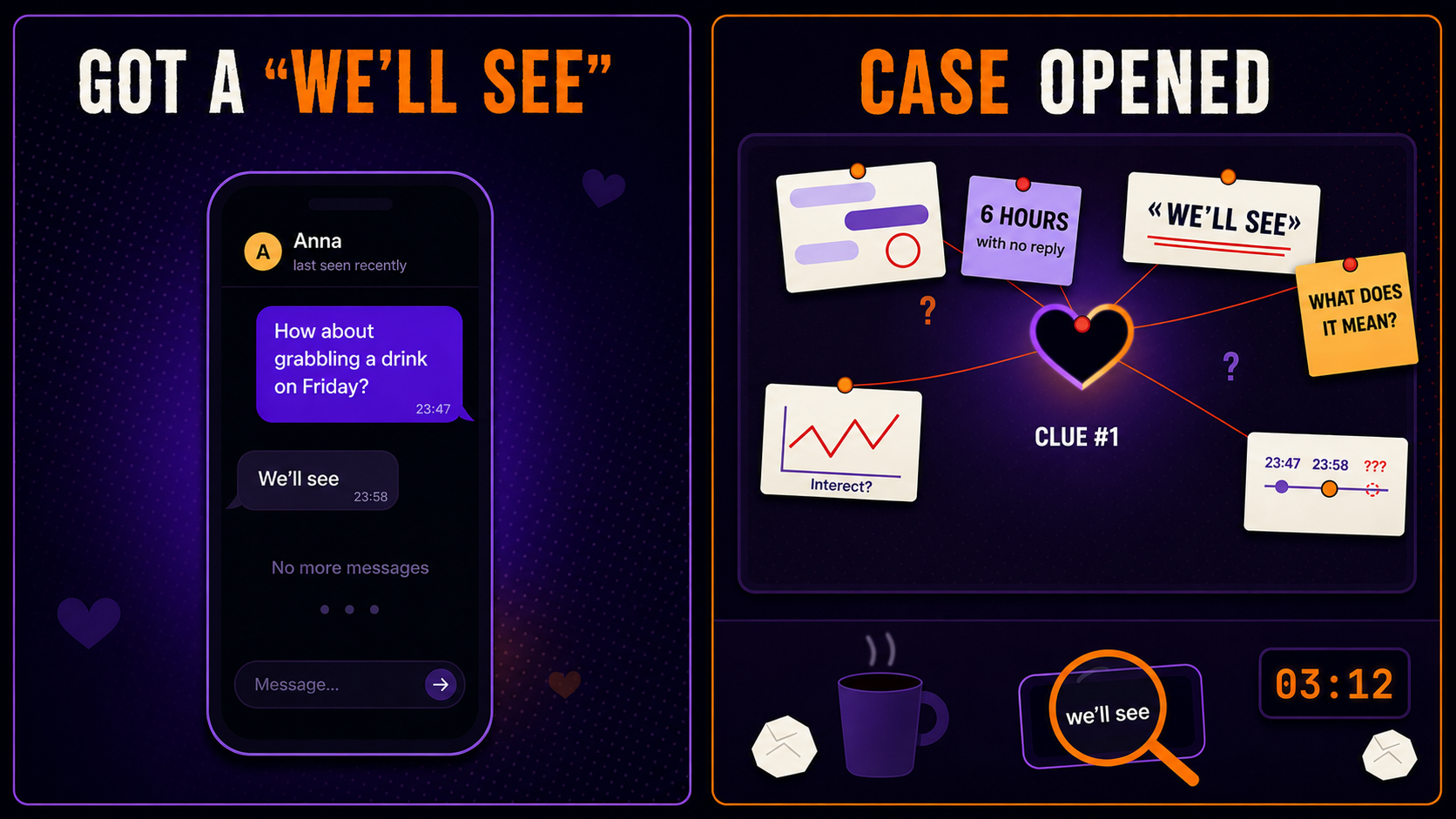
A good read does not hand down a verdict of "into you" or "not into you." It restores context: who started the conversation, what got answered, whether there was any reciprocal effort, where the exchange comes alive and where it drags. In practice that is more useful than any single interest score.
Why people ask for a chat read in the first place
A live conversation gives you pauses, eye contact, tone of voice, the chance to fix a joke that landed wrong. A chat leaves you with text, timestamps, and the occasional emoji. The brain tries to build a full picture out of that small set of clues. Sometimes a very convincing picture. Not always an accurate one.
People bring a conversation in for a read in a handful of recurring situations.
- Right after matching. You want to know if there's real interest and how to keep it going without turning into a quiz show host.
- Before a first date. The other person said yes, but the details keep slipping: "later," "sometime," "we'll see." What you need is not a personality read, just a clear next step.
- After an awkward moment. The conversation felt easy, then one line landed harder than expected — or seemed to. A read helps you see what actually shifted.
- Inside a relationship. The fight is not really about the messages themselves, it's about who keeps avoiding the topic, dismissing it, deflecting, or not hearing the request.
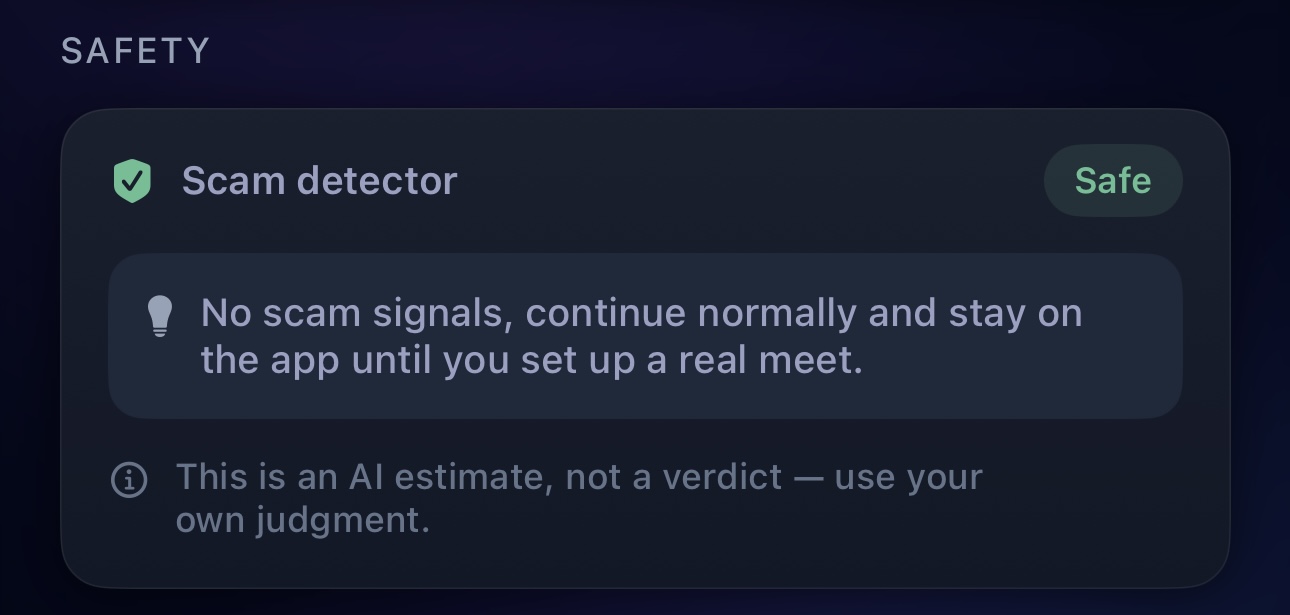
- When something feels off. Pressure, requests for money, moving too fast, threats, attempts to cut you off from friends and family. Here safety matters more than romantic interpretation.
One nuance people tend to skip: a chat shows a communication style over a specific stretch of time, it does not diagnose a person. "He answers three hours later" could mean fading interest. It could also mean a shift change, a commute, being sick, notifications that never arrived, or just not living on the phone. One signal almost never settles anything. A cluster of signals is a conversation worth having.
What a conversation can actually tell you — and what it can't
Ask for a read with a more honest frame than "tell me if he likes me." A chat has data you can actually observe.
You can notice: who keeps the topic going, whether the other person asks questions back, whether they remember details, whether they propose a time or place, how both of you repair contact after an awkward beat, and whether their words line up with their actions.
You can't reliably know: what someone was thinking between messages, how they feel outside this one fragment, the real reason behind every delay, or how the relationship will turn out. Even a very sharp read stays a hypothesis. A useful one, not an all-knowing one.
That points to a good rule: judge the movement of the conversation, not a single line. Picture a tennis serve. One flat "yeah" can be a perfectly normal answer to a specific question. Ten of those in a row, each one leaving you to invent the next topic yourself, stop being a coincidence and start being a pattern.

Five signals that say more than "ok"
1. Reciprocal effort
You don't need to count messages. It's far more telling to check whether the other person is doing anything to meet you halfway: coming back to your question, starting a topic themselves, offering an idea, volunteering a story without being asked. Interest doesn't have to be loud. It usually leaves a trace of effort somewhere.
2. Quality of the reply
"Good" and "good, but after that call I've earned a cake the size of my apartment" technically answer the same question. The second one carries a detail, a mood, and a bridge to keep talking. A real read is useful exactly because it catches that bridge, not just how often someone texts back.
3. Specifics instead of an endless "we'll see"
Once the conversation turns toward meeting up, actions matter. "We should hang out sometime" sounds nice and changes nothing. "I'm free after seven on Thursday, let's meet by the station" is an actual plan. When both people want to meet, specifics don't always show up instantly, but you usually shouldn't have to drag them out.
4. How they handle an awkward moment
In healthy relationships people still miss a message, misread a joke, and get irritated sometimes. The difference is whether you can ask "did I read that wrong?" Does the person own their sharp tone? Can the conversation move past it without a punishing silence? This is one of the most underrated signs of a mature connection.
5. Pace, and whether it's respected
Some people write in paragraphs, some send voice notes, some reply in the evening. The problem isn't a mismatched pace, it's when one person keeps pushing the other to speed up: demanding a reply, getting hurt by a pause, firing off five follow-ups in a row. Enthusiasm that ignores boundaries turns into pressure fast.
How to prep a chat for a read without skewing the picture
The most common mistake is sending a single final line: "so, what do you think." Out of context, it almost always reads worse or better than it actually is. "I don't know" after a warm exchange and "I don't know" after an argument are two different lines.
Take a small but complete piece instead: where the topic started and how it continued. If it's about meeting up, show how the conversation got there and how it ended. If it's a conflict, show the last calm message before things got tense and a few lines after. You don't need a two-year archive. You need enough context to see the turn.
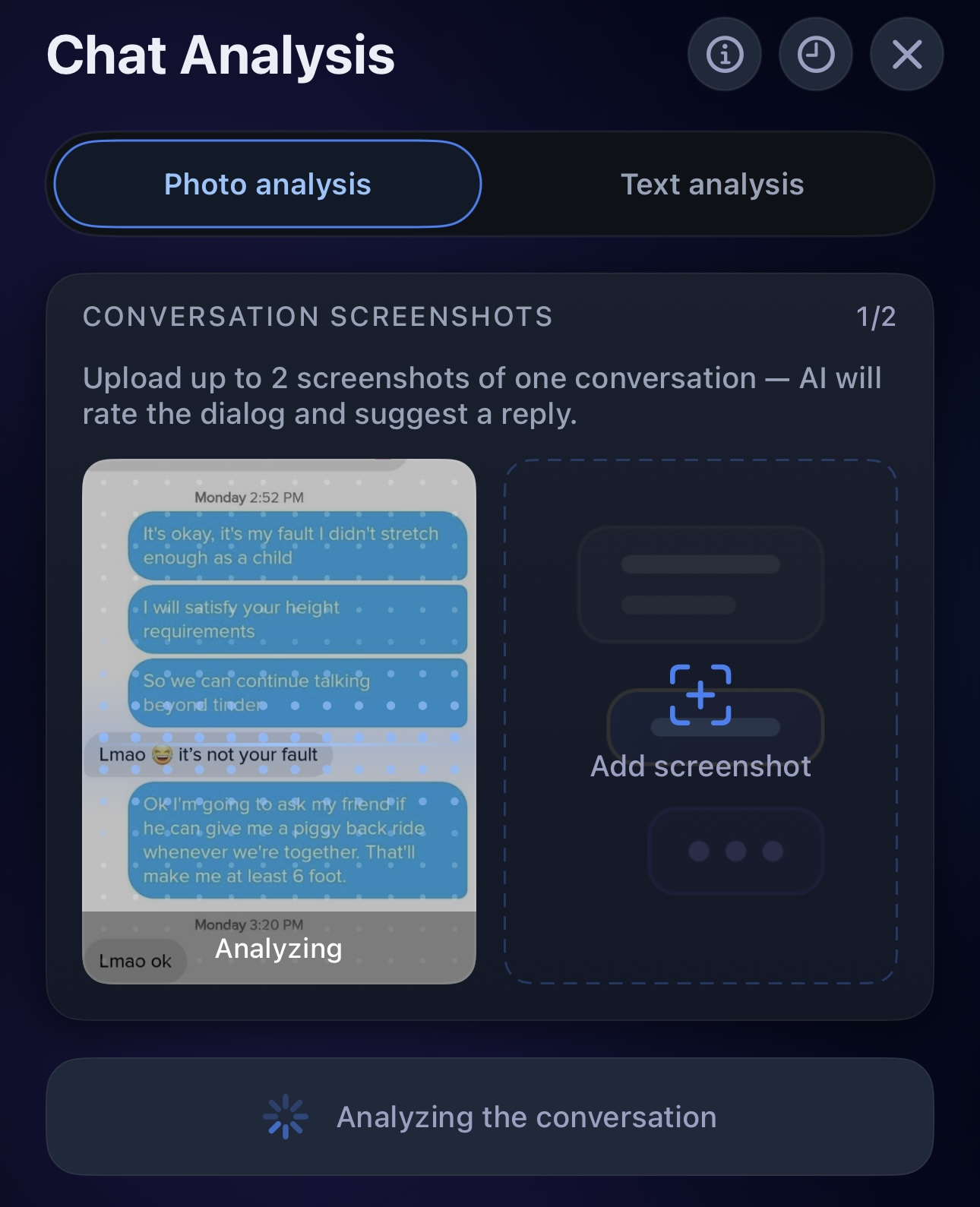
Before uploading anything, black out other people's phone numbers, addresses, workplaces, card details, and any intimate photos. That's just normal digital hygiene, not overcaution. If the conversation involves threats, blackmail, or a risk of violence, save the originals and reach out to people close to you, platform support, or emergency services — a chat read is not a substitute for actual protection.
What ProRoast's Chat Analysis actually shows you
ProRoast lets you upload up to two screenshots of one conversation, or paste the text. It doesn't just look at the last line: it weighs initiative, tone, specificity, and where the conversation is heading. Then it shows a read on the exchange — the other person's interest level, ghosting risk, whether it's time to suggest meeting up, communication styles, and anything that might be quietly pushing them away.
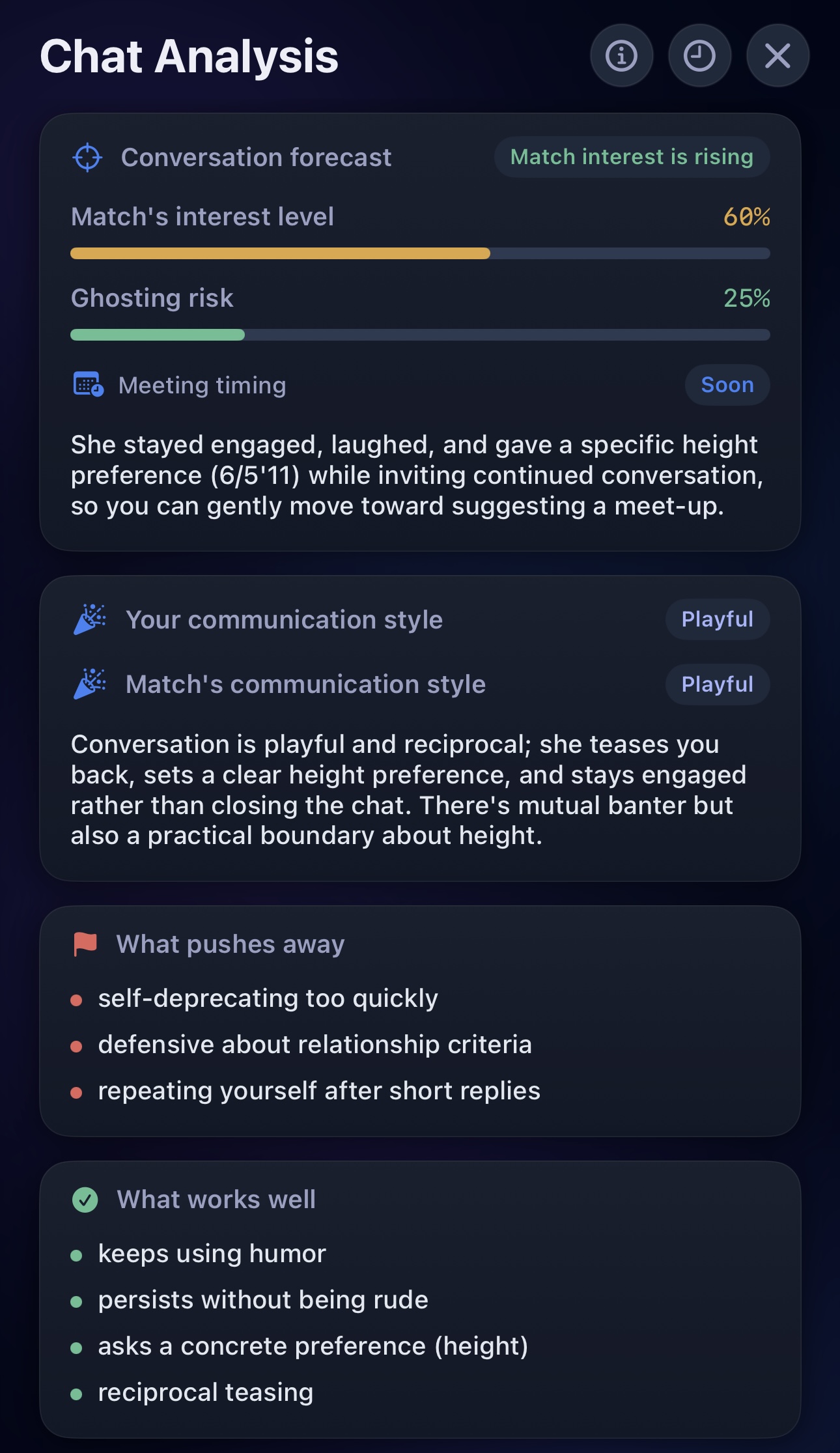
The percentages on that screen aren't a precise measurement of someone's feelings. They're a reference point, best read together with the explanation next to them. "Interest is steady, but it needs specifics" isn't a cue to push harder. It's more of a reminder: instead of another vague message, you can offer something concrete and still leave room for a graceful no.
Take a short exchange as an example. You write, "want to meet up this week?" The reply comes back: "I could do before seven, but I can't stay long." A weak response is to keep the thread going with no actual plan. A better one confirms it: "Let's say 6:15 by the station, coffee for forty minutes, no pressure if plans change." That has a time, a place, a light format, and an easy out. The other person doesn't have to guess what they agreed to.
That's the more useful way to treat a chat read: not as a script for winning someone over at any cost, but as a way to make your own next message clearer and more respectful.
When a read matters most for couples
Couples usually come in with a different question. Not "when do I ask them out," but "why does every conversation end in a fight?" If you want a wider view than a single chat, the relationship health test breaks the picture into ten areas and can be taken by both of you. In the chats themselves, it is worth looking for a repeating sequence:
- One person asks for something specific.
- The other deflects with a joke, gets defensive, or changes the subject.
- The first person raises their tone because they don't feel heard.
- The conversation turns into an argument about wording.
The root cause is often not one bad line, it's that the original request never got acknowledged. Instead of "you never actually answer me," it helps to surface the thought underneath it: "it worries me when plans get canceled without a heads-up, please tell me ahead of time." That's not a magic phrase. But it gives you something real to talk about.
Neither an AI nor a friend should decide for you whether to stay in a relationship. What they can do is point at the part you skimmed past in frustration: where a request turned into an accusation, where sarcasm replaced a direct answer, where someone stated a boundary more than once. Sometimes that's enough to finally move the conversation forward.
Where a useful read ends and spiraling begins
Don't run a check after every single emoji. If a read becomes a way to get the same reassurance over and over, it stops helping. At that point it's more honest to take a break, get back to your own life, and come back to the facts later.
There's another trap: hunting for the perfect message. It doesn't exist. What exists is a line that matches your actual intent, is clear to the other person, and doesn't cross their boundaries. Sometimes the best reply is "got it, thanks for being honest." Sometimes it's one specific question. Sometimes it's not texting back a second time at all.
If you're being consistently put down, scared, isolated, financially controlled, or pressured for intimate content, don't try to fix the tone with the right line. That's not a communication problem to solve. What you need is distance and support.
A short checklist before you hit send
- What do I actually want from this message: a fact, a meetup, an apology, some space?
- Does the other person have an easy way to answer or say no?
- Can I swap a guess for an actual question?
- Am I looking at a pattern across several messages, not just one line?
- Am I trying to hand off a decision that's really mine to make?
The best outcome of a chat read, in my view, isn't "the online oracle says it'll all work out." It's a moment of clarity. "There's interest, but it's time to suggest a time." Or: "I'm reading this pause as a no without a reason." Or maybe, in this particular fight, I didn't actually hear the request. That clarity is what leads to an action — calm, specific, and yours.
Frequently asked questions
Can you read a chat with someone you barely know?
Yes, as long as you don't ask the read to do the impossible. Early on, focus on reciprocity, respect for boundaries, clarity of intent, and whether the other person keeps the conversation going. Two messages won't reveal a personality. A handful of exchanges is usually enough to spot a communication style.
Will a chat read tell me if someone likes me?
It can surface signs of interest or distance: questions coming back, initiative, concrete plans, real engagement with the details. But feelings don't reduce to a score. If the stakes are real, a plain, direct question at the right moment still works better than anything else.
How is a chat read different from talking to a therapist?
A chat read helps with one specific piece of conversation and what to send next. It's not a replacement for a therapist, especially if the relationship keeps producing the same heavy conflicts, fear, control, or the aftermath of trauma.
Which part of a conversation should I actually submit for analysis?
Pick the start of a topic and its continuation, not one line ripped out of context. Hide personal details first. The more specific your question is going in — "is there real reciprocity here?", "how do I suggest meeting up?", "where did this conflict actually start?" — the more you'll get out of the read.
You can also practise on a low-stakes version first: the AI girl chat trainer gives you a scripted partner, five messages and a breakdown with an interest score. If the thread keeps dying for lack of material, start with what to talk about with a girl. And if you want to see how this differs from a plain reply generator, there's a separate Rizz.app review.